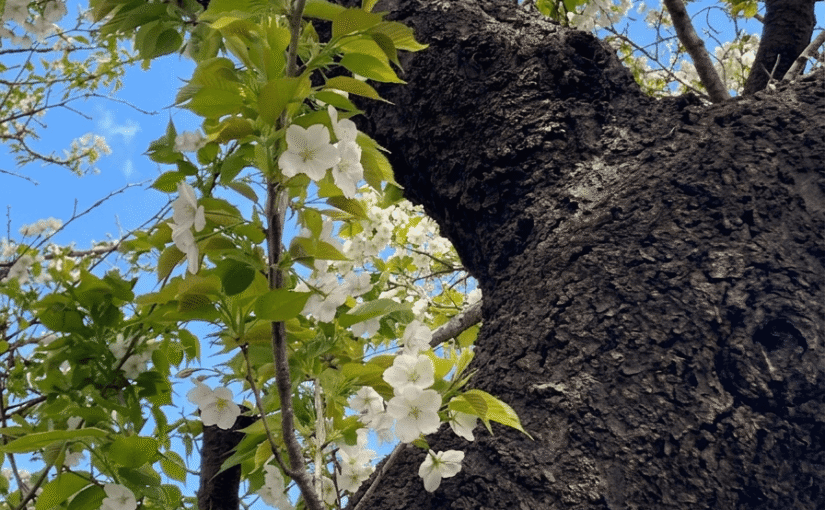
Today, I’d like to take a deep dive into the Oshima Cherry (Oshima-zakura).
Why this specific tree? To be honest, I’ve always been captivated by the way its blossoms and fresh young leaves emerge at the very same time—a beautiful harmony of crisp white and vibrant green. There is also something deeply satisfying about its bark; in younger trees and established adults, the trunk carries a subtle, polished luster that catches the eye.
And, of course, I cannot talk about this tree without mentioning Sakura-mochi. That iconic Japanese rice cake, wrapped in a salted cherry leaf, owes its unmistakable aroma and unique texture to the Oshima Cherry. For many of us, the soul of this sweet treat lies right there in the leaf.
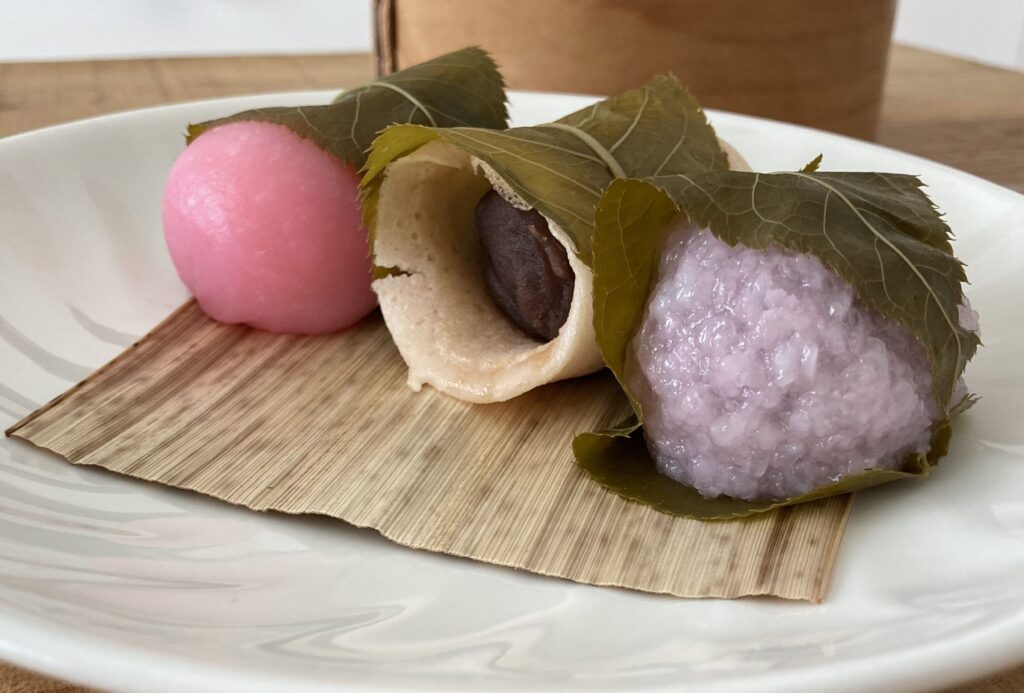
From left to right: Sakuradango, Sakuramochi. DomyojiMore Than Just a Fragrant Wrap: The True Identity of the Oshima Cherry
Think of that rich, sweet aroma that comes with every bite of Sakura-mochi. The large, fragrant leaf wrapping the rice cake is, in fact, the leaf of the Oshima Cherry. But its “greatness” goes far beyond just being delicious.
In the volcanic regions of the Izu Islands, this tree is known as a “pioneer.” Even in harsh, desolate landscapes covered in cooled lava, it is among the first to take root. It doesn’t just survive; it actively reshapes the environment around it.
So, what is the secret strategy of the Oshima Cherry? How does it face the rugged ground beneath its feet and turn it into something new? Let’s explore its remarkable survival strategy.
Starting from the Lava: A Survival Strategy as a Pioneer Species
The homeland of the Oshima Cherry is the volcanic landscape of the Izu Islands. Looking at the polished, elegant bark of the younger trees or the succulent green leaves that sprout in early spring, it’s almost hard to imagine such a rugged origin.
This tree is a wild species native to Japan, growing naturally along the coasts of the Izu Islands and the southern Kanto region. In fact, it gets its name from the island of Izu Oshima, where it has flourished for centuries.
Broadly speaking, these volcanic islands fall into two categories: “black” islands made of basalt and “white” islands made of rhyolite. Izu Oshima, the namesake of our cherry tree, is the “black” type—a landscape forged from dark, volcanic rock.
Volcanic Island Types: A Comparison
| Characteristics | Basaltic Islands (The Black Islands) | Rhyolitic Islands (The White Islands) |
|---|---|---|
| Primary Islands | Izu Oshima, Miyakejima, Hachijojima | Niijima, Shikinejima, Kozushima |
| Magma Nature | Low viscosity (Runny and fluid) | High viscosity (Thick and sticky) |
| Landscapes | Gentle slopes; stratovolcanoes | Dome-shaped mountains; sharp cliffs |
| Ground & Sand | Dark/Black (Volcanic ash, scoria) | Pure White (Koga-seki stone, volcanic glass) |
| Key Spots | Mt. Mihara, Ura-sabaku (Izu Oshima) | Shiro-mama Cliffs (Niijima) |
In places so harsh that most plants would give up before even trying, the Oshima Cherry is the first to sprout. It all begins with a single seed carried by a bird—our essential little messenger. From that tiny seed, the tree twists its roots into narrow cracks in the rock and stretches toward the sun faster than anyone else.
And it’s not just the lack of nutrients they face. They also endure the relentless salt winds blowing off the sea and the extreme dryness of the scorching sun. Yet, for the Oshima Cherry, all of this seems to be “exactly as expected.”
This toughness, forged in such a brutal environment, is precisely why this tree was chosen as the ancestor for so many cultivated varieties, including the famous Somei-yoshino.
Knowing this history, the dignified presence of the tree and even the unique flavor of its leaves suddenly make perfect sense. It is a beauty and a taste earned through survival.
Creating Life from Within: The Strategy to Enrich the Soil
The leaves of the Oshima Cherry are notably larger and thicker than those of other cherry varieties. It makes perfect sense why these specific leaves were chosen to wrap Sakura-mochi—it’s all thanks to their ideal size and sturdiness. But this “large leaf” holds a hidden, vital strategy for survival…
Falling Leaves as Natural Fertilizer
Come autumn, these large leaves dance down to the ground all at once. Covering the earth in a thick layer, the fallen leaves act like a “blanket,” protecting the soil from the winter cold and dryness. Then, tiny microbes—some hiding in the cracks of the lava, others carried by the wind or birds—begin to break down these leaves, transforming them into rich, fertile humus. We really owe it all to these hardworking microbes!
Life Even on Bare Lava!
At first glance, cooled lava looks devoid of life. However, it’s actually home to resilient organisms like lichens and specialized rock-dwelling bacteria. They slowly wear away the rock surface, dissolving and releasing minerals.
When the large leaves of the Oshima Cherry pile up on top, they become a “home” for these microbes:
- Moisture: Lava dries out quickly, but a layer of leaves traps vital water beneath.
- Food: The fallen leaves provide the ultimate source of nutrients.
With a cozy home and plenty of food, the microbes begin to multiply rapidly, cheering, “We can live here!”
As they consume the leaves, the decomposed organic matter mixes with the tiny particles of eroded lava. This mixture becomes the “first millimeter of soil”—the very foundation that, centuries later, will support a deep, lush forest. Just one millimeter! It sounds so small, but when you imagine it spreading across the entire landscape… it’s quite a feat, isn’t it?
In a barren land of lava where no nutrients exist, the Oshima Cherry collaborates with microbes through its fallen leaves to create a self-sustaining cycle. Slowly but surely, the hard ground softens, transforming into the rich, “fluffy” soil that life needs to thrive. Truly, cooperation is the key to everything.
Roots as “Nature’s Cultivators”: The Power to Pierce Through Rock
To survive in the desolate, nutrient-poor lava fields, the roots of the Oshima Cherry are incredibly powerful. When they find even the tiniest crack in the rock, they wedge themselves in, thickening with such force that they can actually split the stone apart. This “root power” creates gaps in the rock, opening up “paths” for air and water to flow through the once-solid ground.
A Natural “Soil Anchor” and Hidden Network
Their roots don’t just dive deep; they also spread wide like a sprawling net. This acts as a natural anchor, firmly gripping the earth to prevent landslides and stop the precious topsoil from being washed away by wind and rain. In the harsh environment of an island, the tree isn’t just securing its own spot—it’s also playing a humble yet vital role in protecting the island itself.
Where these trees have taken root, tilled the soil, and created space, other trees and wildflowers eventually find a place to grow. The “underground paths” carved by the Oshima Cherry become a lifeline for other species. This network serves as the “infrastructure” that will support a lush, thriving forest hundreds of years from now. All of this, starting from a single fallen leaf… it’s truly remarkable.
I am deeply moved by this brilliant strategy (whether by chance or a shared purpose). Exploring the story of the Oshima Cherry has been a truly eye-opening journey.