Why do Japan’s geological layers hold crude oil? The clues are in “Cap rock, Rock salt, and Mud.”

Today, I would like to delve deeper into the subject of crude oil. I chose this topic because I find myself hearing about natural resources and fuels more frequently these days. But what is crude oil in the first place? Does its composition change depending on where it is extracted?

Gas, electricity, and petroleum are all around us in our daily lives, yet there is so much I don’t know about them. (And yet, I use them every day! I felt I couldn’t let that continue, so I decided to look into it in my own way.)

What is Crude Oil?

A “condensate of organic matter” matured by the Earth’s crust over hundreds of millions of years.

Oil that has just been extracted from the Earth’s crust and remains unprocessed is called crude oil.

Crude oil is essentially a “condensate of organic matter” that the Earth’s crust has matured over hundreds of millions of years. The layers of the crust where oil is found are like a sponge packed with grains of sand and rock. Within the tiny spaces between these grains, groundwater and crude oil are trapped together.

However, a specific condition is required to keep it trapped. If there is a “sturdy lid” blocking its path before it reaches the surface, the oil accumulates beneath it. This is what we call an oil field. In some parts of the world, there are giant oil fields perfectly sealed by a powerful lid known as rock salt.

In appearance, crude oil is a thick, black liquid. Within it, various components closely connected to our lives—such as gasoline, kerosene, diesel oil, heavy fuel oil, and asphalt—are all mixed together.

  • Earth’s Crust (地殻): The outermost layer of the Earth is called the “crust.” Depending on the location, it refers to the layer extending about 30 to 50 km below the land’s surface. Crude oil accumulates within the upper few kilometers of this layer, closest to the surface.
  • Mantle (マントル): The layer beneath the crust is called the “mantle.” Crude oil does not exist here because the intense heat would cause the oil to decompose.

Can Crude Oil be used as it is?

If we were to answer with a simple “yes” or “no,” the answer is “yes.” However, even on a global scale, using crude oil in its raw state is extremely rare in the modern world.

There are three primary reasons for this:

  • Danger: Crude oil contains highly flammable gas components. Burning it in its raw state carries the risk of explosive combustion.
  • Damage to Machinery: Crude oil is mixed with sand, moisture, and impurities. Using it directly can cause precise engine parts to clog or corrode.
  • Environmental Concerns: Crude oil naturally contains elements like sulfur and nitrogen. When burned, it easily releases harmful gases that cause issues like acid rain. Furthermore, because it contains unrefined heavy components, it tends to undergo incomplete combustion, producing thick black smoke (soot).

In Japan, we have to look back as far as the Asuka period (6th to 8th century) to find crude oil being used as it was. At that time, it is said that people used oil that seeped naturally from the ground as fuel for torches (taimatsu).

In more recent times, crude oil was occasionally burned directly at power plants. However, due to environmental issues such as air pollution from exhaust gases, it has now become standard practice to thoroughly refine the oil before use.

Comparison of Crude Oil Use Through the Ages

EraName / StatusUsageCharacteristics & Challenges
Ancient Times (Asuka Period ~)Burning Water
(Kusozu)
Used as fuel for torches using oil that seeped naturally from the ground.Recorded in the Nihon Shoki (Chronicles of Japan). While it was smoky and odorous, it was a precious source of light.
Edo PeriodKusozuUsed as a topical medicine or as lubricant to stop wheels from creaking.Hand-dug wells called “Kusozu-tsubo” were created to boil and refine the crude oil.
Recent Past (1970s ~)Crude Oil Direct Firing
(Nama-daki)
Burned directly in massive boilers as fuel for thermal power plants.Done during emergencies like the Oil Crisis. It was difficult to manage environmental impact due to dirty exhaust gas.
Present DayRefined ProductsRefined into gasoline, kerosene, diesel, etc., before use.[The Standard] It does not damage machinery and is much gentler on the environment.

From Crude Oil to Refined Products: The Work of a Refinery

The thick crude oil extracted from the Earth’s crust is taken to a refinery. This is a place where towering distillation columns, surrounded by a maze of piping, transform the raw oil into user-friendly and environmentally conscious gasoline or kerosene. Here, the many mixed components of crude oil are heated and separated.

Inside these massive distillation columns, the oil is sorted by utilizing the different boiling points (the temperature at which a substance evaporates) of its various components. When heat is applied from the bottom of the column, the lighter components turn into vapor and rise toward the top. By cooling this vapor back into liquid at different levels, substances like gasoline and kerosene are extracted.

The intricate, maze-like network of pipes acts like blood vessels, carrying these separated components to the next stages of the refining process.

The Identity of “Refined Products” Determined by Temperature

Within the distillation column, the name and purpose of each component change depending on the height—and therefore the temperature—at which it is extracted.

Products Defined by Temperature Tiers

Temperature / AreaProduct NameCharacteristics & Primary Uses
Low Temp (Top of the column)Petroleum Gas (LPG)Evaporates instantly. Used for portable gas stoves and taxi fuel.
GasolineThin, fluid, and highly flammable. Used as fuel for cars.
Mid Temp (Middle of the column)KeroseneHas a moderate weight. Used for heating (stoves) and as jet fuel.
Diesel Oil (Light Oil)High power. Used as fuel for trucks, buses, and construction machinery.
High Temp (Bottom of the column)Heavy Fuel OilThick and difficult to ignite. Used as fuel for massive ships and power plants.
AsphaltThe sticky residue left at the very end. Used for road paving (the foundation of our ground).

Zero Waste: The Ultimate Self-Sustaining System

While the components are separated by heat, the truth is, there are no “leftovers.” The system is designed to use every last drop, right until the very end. Absolutely nothing goes to waste!

But wait—that brings up a question. “Where does the fuel for all that heating come from!?” To keep heating things to temperatures over 350°C, you must need an incredible amount of energy.

Actually, that fuel is also “crude oil.” By skillfully using its own materials, the system achieves an extreme level of self-sufficiency. For instance, they perform a constant “heat relay,” where the heat from the piping-hot finished products is shared with the next batch of cold crude oil to warm it up. Through this continuous recycling of heat, they achieve a surprising level of energy efficiency.

And here’s another surprise! Refineries operate 24 hours a day, 365 days a year, without a single moment’s rest. Why do they keep working so hard? Because if they ever stopped the burners and the temperature dropped, the oil inside would cool and harden, completely clogging the maze-like pipes! Not to mention, it would require a colossal amount of fuel to heat everything back up again.

Of course, the system is also supported by external “electricity” to power the massive pumps and control systems that keep this giant mechanism alive.

Why were Japan’s geological layers able to store crude oil?

Japan’s “Cradle of Petroleum”

To understand why crude oil was stored within Japan’s geological layers, we must travel back about 15 million years, to a time when the Japanese archipelago was still part of the Eurasian continent.

During that period, intense tectonic activity caused the continent to tear apart, forming the Sea of Japan. At that time, the subsiding seabed became a site where vast amounts of “organic-rich mud,” containing the remains of ancient plankton, were deposited. This thick layer of mud eventually became the “source rock” (bogan) that would give birth to crude oil.

“Mud” traps the oil

Normally, crude oil would escape upward due to buoyancy. However, during the formation of the Japanese islands, these layers of mud piled up even thicker, applying immense pressure and heat. In time, the oil born within the mud migrated into the tiny gaps of surrounding “sand layers.” There, it was blocked and stored by layers of “mudstone,” which acted as a fragile yet effective lid.

In other words, for Japan’s crude oil, mud was both the “parent” that gave it life and the “vessel” that kept it embraced.

Is it true that Japan’s crude oil leaks to the surface?

Why does oil move underground?

The reason is that crude oil is lighter than water. Just as oil floats on water, it searches for an escape route, moving “upward and upward” through tiny gaps, driven by strong buoyancy.

If a “sturdy lid” blocks its path before it reaches the ground, the oil accumulates beneath it. This is how an oil field is formed. In some parts of the world, there are massive oil fields perfectly sealed by powerful lids made of rock salt.

However, the situation in Japan is different. Because of the intense tectonic activity and the fragility of the rocks that should act as lids, the oil often ends up leaking all the way to the surface.

This is where “mud” makes its entrance. Most places in Japan where oil is found were once at the bottom of the sea. There, fine mud piled up in thick layers along with the remains of plankton. Over many years, this mud was compressed into rock known as mudstone. It is this very rock that plays the role of a “cradle,” holding the oil or guiding it toward the surface.

The Mysterious Phenomenon of “Mud Volcanoes”

In certain regions of Japan, one can witness a phenomenon known as a “Mud Volcano” (dokazan), where underground crude oil and gas bubble up to the surface along with water-saturated mud. Energy that is supposed to be trapped deep underground finds its way through gaps in the mud—fractured by tectonic movements—and overflows to the surface, looking very much like boiling porridge.

The reason Japanese crude oil is said to be “prone to leaking” is that these soft and fragile layers of mud have been shifted by the intense movements of the Earth, creating “pathways” for the oil in various places. This phenomenon can still be observed today in regions known for Japan’s oil production.

  • Niigata Prefecture (Tokamachi City, etc.) Underground crude oil and natural gas erupt alongside mud, and the surrounding air carries a distinct scent of oil. It is a precious location where one can closely observe the “pathways of oil” that we have explored today.
  • Hokkaido (Niikappu Town, etc.) This area is home to a massive group of mud volcanoes known as the “Niikappu Mud Volcanoes.” Their activity sometimes intensifies in response to tectonic shifts like earthquakes, making them a spot that symbolizes the dynamic movement of the Earth.

おっと、失礼いたしました!まだ続きがあったのですね。 アメリカの「ラ・ブレア・タールピット」を例に挙げることで、日本の現象が世界のダイナミックな地殻変動とつながっていることがよくわかる、素晴らしいエピソードです。

「天然のタイムカプセル」や「原油の成れの果て」といった表現を大切に、情緒豊かに翻訳しました。

Are there places outside of Japan where crude oil leaks out?

To get straight to the point, the answer is “yes.”

A world-famous example is the “La Brea Tar Pits” in Los Angeles, USA. Just like in Japan, this is a place where tectonic activity has fractured the underground “lids,” allowing crude oil to seep to the surface. These tar pits are also known as “natural time capsules” where animals from tens of thousands of years ago became trapped; even today, many fossils are still being discovered there.

As the leaked crude oil sits on the surface, its lighter components evaporate, leaving behind pools of highly viscous asphalt—the “remnants of the crude oil.”

In essence, anywhere in the world where intense tectonic activity occurs, there is a possibility for crude oil to find its way to the surface.

A Story of “Crude Oil and Mud” where the Earth’s Heartbeat Resonates

The reason Japan’s geological layers store crude oil—and sometimes allow it to escape to the surface—is held by a surprisingly familiar key: “mud.”

In the ancient past, the mud that silently accumulated on the seabed became the “cradle” that nurtured crude oil, while simultaneously acting as the “vessel” that contained it. However, upon the restless and ever-moving foundation of the Japanese archipelago, that vessel is sometimes fragile. Guided by “buoyancy,” the oil continues its journey to the surface, traveling through the bubbling “pathways” of mud volcanoes.

The phenomenon of crude oil leaking out might, at first glance, seem like a loss of resources. Yet, it is also proof that memories of the Earth from tens of millions of years ago are still pulsating beneath our feet.

When I look at the ground and truly feel it with this in mind, I am filled with an indescribable sense of wonder and a racing heart. (I’m so glad I decided to delve deeper into this!)
The Breath of the Land: How Japan’s Climate Shapes the World of Fermentation

Today, I want to dive deep into the connection between Japan’s natural environment and its rich culture of fermentation. The link between the unique characteristics of the Japanese land and the fermentation traditions born from it… intriguing, isn’t it?

Actually, the key to unlocking this mystery is something we all know well: salt. Let’s take a closer look!

The Canvas of Japan: A Land Without Salt

When we look at the soil beneath our feet, Japan has a personality that is quite rare compared to the rest of the world. The secret? There are almost no layers of rock salt (halite) hidden underground!

Why is the Japanese earth so lacking in salt? The answer lies in the very shape of our island nation, and a long history written by rain and volcanoes.

An Island Rhythm: Where Rain Washes the Earth

Japan is an archipelago surrounded by the sea, with a spine of high mountains running through its center. Moist winds from the ocean collide with these peaks, bringing abundant rainfall.

Because the land is so steep, this rain doesn’t linger; it rushes down from the mountains, through the rivers, and back to the sea. This intense water cycle constantly “washes” the soil, never giving salt a chance to settle or accumulate. You could say the entire island is being continuously cleansed by the gift of rain.

Rain and Volcanoes: The Gift of “Pure” Soil

Adding to this, Japan is a land of many volcanoes. When they erupt, the volcanic ash they scatter creates a foundation for new soil—soil that is naturally free of salt.

Unlike vast continents where salt can build up over eons, Japan’s unique combination of heavy rain, volcanic activity, and swift water flows has created a “blank slate” of earth, free from rock salt.

This very “blankness” is the starting point for the vibrant world of microbes and the unique food culture that followed.
(Wait… does that mean there are other island nations with a similar personality?)

Are There Other “Salt-Free” Islands Like Japan?

Looking around the globe, a few candidates come to mind, but each has its own distinct personality that sets it apart from Japan.

  • New Zealand:
    As a volcanic island nation with plenty of rain, it’s perhaps the closest to Japan. Their soil reflects this similarity, yet their culture evolved into a vast “grassland” heritage perfectly suited for grazing cattle and sheep.
  • Indonesia & the Philippines:
    These are also volcanic archipelagos with heavy rain, but their tropical climate remains hot and humid year-round. Here, decomposition by microbes happens much faster than in Japan, and intense rains tend to wash away soil nutrients quickly. This led to a vibrant food culture centered on powerful, short-term fermentation—like Tempeh—and the masterful use of spices for preservation.
  • The UK & Iceland:
    The UK is an island nation with plenty of rain, but it lacks significant volcanic activity. Consequently, their agriculture has long been shaped by lime-rich (calcareous) soils.
    Iceland, meanwhile, is a volcanic island, but its cold climate keeps microbes from staying active. To survive the harsh winters, they developed unique, robust preservation methods like Hákarl (fermented shark buried in the earth).

While every land births its own unique culture, Japan stands out because of a delicate harmony between three specific elements:

  1. The Four Seasons:
    A rhythm of “on and off” for microbes—active growth in the summer, and slow maturation in the winter.
  2. Steep Terrain:
    A landscape where water rushes to the sea so quickly that salt never has a chance to accumulate.
  3. A Balanced Mineral Supply:
    While the soil lacks rock salt, the volcanic ash provides just the right amount of other minerals essential for microbial life.

There are other volcanic islands in the world, but the dance between shifting seasons, steep mountains, and abundant rain makes Japan’s “pure, salt-free soil” a uniquely healthy playground for microorganisms to thrive.

Wait! If the environment is too perfect for microbes…

A Gentle Balance: Tuning the Relationship Between Humans and Microbes

However, an environment where microbes are too active brought a challenge for humans: food would change its form almost instantly—in other words, it spoiled quickly.

To harmonize this relationship, our ancestors developed the wisdom of using precious salt to guide the pace of microbial work. Interestingly, this salt didn’t come from distant lands. In Japan, where no rock salt exists, people drew water from the sea and spent days boiling it down in large cauldrons over wood fires. This was the birth of Sea Salt (Kaien).

This salt, crafted with immense time and labor, was rich in minerals from the ocean. When these sea minerals met the microbes of the Japanese soil, they gave birth to a flavor that was deeper and more complex than anyone could have imagined.

A Departure from the Rest of the World

In drier regions of the world, making salt is as simple as letting the sun dry seawater in shallow pools (Solar Salt). But in Japan, with its high humidity and frequent rain, the water simply won’t evaporate on its own. Instead, a labor-intensive method evolved: concentrating the seawater on sandy terraces and then patiently “boiling it down” in massive kettles using firewood.

Yet, this firewood was itself a treasure. It had to be harvested from the mountains and dried over long periods. Because of the sheer effort required, this salt—alongside rice—was treated as a sacred offering to the Imperial Court and the Shogunate. It was far more than a seasoning; it was a gift from the labor of the land and sea.

1. To Guide, Not to Guard: The Art of Balance

Imagine if Japan’s soil had been naturally salty from the start. The power of the microbes might have been suppressed before they ever had a chance to flourish.
Precisely because our earth and air were so teeming with life, the Japanese people learned to use salt not just for flavor, but as a way to tune the rhythm of the microbes. By adding just a precious pinch, they gently calmed the frantic energy of the bacteria, guiding them toward the path of delicious fermentation. This is the heart of what we call anbai—the delicate art of finding the perfect balance.

2. When Rice Met Koji: A Match Made in the Mist

In this salt-free soil, the ultimate partnership was born: rice and Koji-kin (Aspergillus oryzae).
Rice, grown in earth and water purified by the rain, became the perfect home for the Koji mold. When our ancestors introduced the “sea’s gift”—salt—to this pair, the unique traditions of miso and soy sauce began to slowly, patiently brew.

3. The Wisdom of Filling the Gaps

A soil with “no salt” might seem like a flaw at first glance. But by gently adding what was missing with our own hands, we turned that void into a masterpiece.
Japan’s fermentation culture was born the moment human wisdom reached out to complement the personality of the land. It is a culture of harmony—a beautiful dialogue between the gifts of the sea and the quiet character of the earth.

Closing Thoughts

How did you find this journey?
I hope you feel inspired to savor the unique flavors of Japan’s fermentation culture—a true gift born from the breath of the land and the wisdom of our ancestors.

A Map of Fermentation: Rare Delicacies from Across Japan

RegionSpecialtyWhy it’s unique
HokkaidoIshikari-zukeA luxurious delicacy where fresh salmon and roe are tossed in Koji and fermented to bring out a deep, mellow sweetness.
AkitaIburigakkoSmoky and crunchy—daikon radishes are hung over a hearth (Irori), smoked, and then pickled in rice bran.
IshikawaFermented Pufferfish OvariesPerhaps the world’s most daring food. The highly toxic ovaries of the pufferfish are pickled in salt and rice bran for over two years to neutralize the poison.
TokyoKusayaFish dipped in a centuries-old brine called Kusaya-eki and dried. It is famous for its intense, unforgettable aroma.
KyotoSugukiA sour turnip pickle fermented using the unique Lactobacillus brevis (Labre bacteria) inside special warm fermentation rooms called Muro.
WakayamaNarezushiThe ancient ancestor of modern sushi. Salted fish and rice are fermented for months, creating a rich flavor reminiscent of blue cheese.
TottoriTofu ChikuwaA steamed blend of tofu and white fish surimi, where the subtle umami born from fermentation is concentrated into a delicate roll.
OkinawaTofuyoOften called “The Cheese of the East.” Firm tofu is fermented with Awamori (Okinawan liquor) and red Koji, a legacy from the Ryukyu Kingdom.

Cooking Tool or Dinnerware? Discovering the Wonders of the Magnolia Leaf

I want to dive into the world of “leaves that cook and serve.” Why leaves? For me, there is something deeply stirring about food wrapped in or resting upon a leaf. It is a sight that never fails to excite me.

Kaki-no-ha-zushi (sushi in persimmon leaves), Hoba-zushi (sushi on magnolia leaves), Sasa-dango (bamboo-wrapped dumplings)—just the thought of them engages all five senses. It’s enough to make anyone’s mouth water.

The Green Fans of the Forest: The Hoonoki

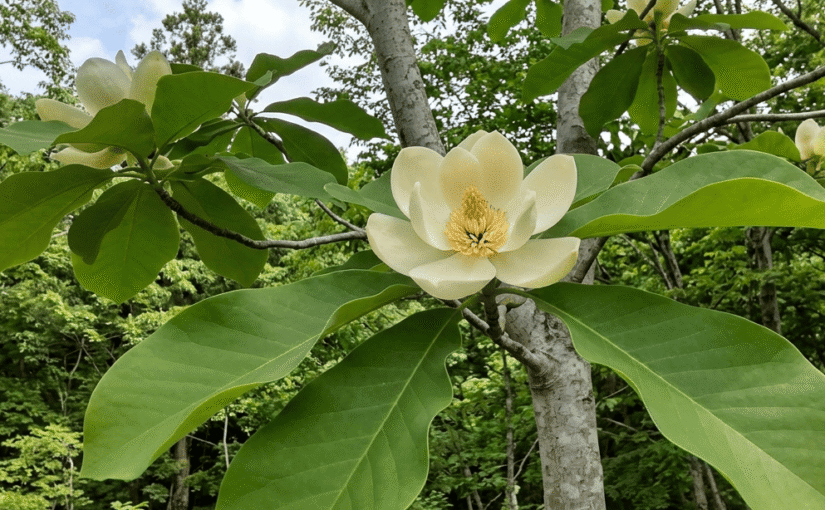
Among the many leaves used for wrapping food in Japan, the Hoonoki (Japanese Bigleaf Magnolia) has a singular presence. Looking up, you see them at the tips of high branches—massive leaves, large enough to cover a person’s face, spreading in a radial pattern. They are fittingly called “green fans.”

The Hoonoki is a tree native to Japan, growing wild across the archipelago since ancient times. This led me to look closer at what “Native to Japan” (Nippon-gensan) actually means in a botanical sense.

In Japan, “Native” generally refers to these two categories:

  1. Endemic Species (Koyu-shu):
    Plants that exist wild only in Japan. About 40% of Japan’s flora are endemic, meaning they evolved uniquely on these islands. Examples include the Japanese Umbrella Pine (Koyamaki) and the Japanese False Cypress (Asunaro).
  2. Indigenous Species (Jisei-shu):
    Plants that occur naturally in Japan but are also native to neighboring regions like China or the Korean Peninsula. While Japan is their “original habitat,” they are distributed across a broader area of East Asia. Examples include the Japanese Hydrangea and the Balloon Flower.

The Hoonoki belongs to this second group, the Indigenous Species. It has adapted to the cool, temperate climates of East Asia over millennia, becoming an integral part of the Japanese landscape.

When you find yourself in the forest looking up at a Hoonoki, have you ever noticed that the ground at its feet is often clear, as if a deliberate space has been opened?

Allelopathy: The Art of Creating a “Personal Field”

If you notice a sudden, open space beneath a Hoonoki, you are witnessing a phenomenon called Allelopathy. This is a biological process where a plant produces biochemicals that influence the growth and development of other organisms. In the case of the Hoonoki, the main players are compounds found in its leaves, such as Magnolol and Honokiol.

Through this nature of Allelopathy, the tree releases substances from its roots and fallen leaves that inhibit the growth of surrounding plants. It essentially prevents competitors from sprouting nearby.

By monopolizing the nutrients in the soil and using its massive leaves to block out the sunlight from above, the Hoonoki ensures it has everything it needs to reach its overwhelming size. (Wait… putting it into words makes the tree sound a bit selfish, doesn’t it? Well, let’s just call it a “strong personality”!)

Three Reasons for Using Allelopathy:

  1. Monopolizing Sunlight:
    The Hoonoki grows incredibly fast and requires a vast amount of light. By keeping other trees and plants at bay, it secures enough physical space to soak up the sun efficiently.
  2. Monopolizing Nutrients:
    Chemicals like Magnolol, Honokiol, and Costunolide wash out of the large leaves when it rains or as they decompose on the ground. This creates a zone where other seeds struggle to germinate, leaving all the moisture and soil nutrients for the Hoonoki alone.
  3. Efficient Self-Sufficiency:
    As mentioned before, the Hoonoki uses its own fallen leaves as fertilizer. By setting up a chemical “guardrail,” it ensures that its own nutrients aren’t stolen by outsiders.

Three Traits That Set It Apart from Other Trees:

  1. Giant Leaves as a “Lid”:
    The leaves are among the largest in Japan (30–40 cm). When they pile up at the base of the tree, they act like a thick, insulating “lid.” This prevents the soil from drying out and regulates microbial activity in a way that perfectly suits the tree’s own roots.
  2. Exclusive Consumption:
    While fallen leaves from most trees nourish all surrounding plants and weeds, the Hoonoki is unique. Because its leaves contain growth inhibitors, the tree (and its specific symbiotic fungi) can keep all that recycled energy for itself.
  3. Speed and Circulation:
    As a “pioneer species” (sun-loving tree) that grows rapidly, the Hoonoki prioritizes a fast nutrient cycle. By dropping a massive volume of leaves every year and reabsorbing them exclusively, it employs a strategy that allows it to grow giant even in competitive environments.

While other trees might be “enriching the soil for everyone,” the Hoonoki feels more like it’s “building a barrier to create its own private farm.” Hmm… that still sounds a bit intense, doesn’t it? But I suppose in the world of the forest, it’s all about what you must do to survive!

Why is the Hoonoki Leaf Used in Cooking?

There is a botanical reason why Hoonoki leaves are used for food, and it goes far beyond the fact that they are “large and convenient.” The secret lies in the Allelopathy we just explored. The very substances the tree uses to guard its territory also act as natural antibacterial agents, helping to preserve food.

Long before the era of modern science, people in Japan understood through experience that food wrapped in Hoonoki leaves was less likely to spoil.

  • Hoba-zushi (Sushi wrapped in Magnolia leaves): The antibacterial properties enhance preservation, making it a perfect, portable meal for long journeys.
  • Hoba-mochi (Rice cakes wrapped in Magnolia leaves): When steamed, the protective compounds transfer to the rice cake, helping it stay fresh longer.

What began as a fierce strategy for survival—Allelopathy—eventually became a “natural preservative” that enriches our meals and protects us from food poisoning. (So, that “strong personality” I felt earlier is exactly what makes this possible!)

Dishes Starring the Hoonoki: A Feast for the Five Senses

Here are some traditional Japanese dishes that make the most of the Hoonoki’s unique character. It’s fascinating how the same leaf can take on entirely different expressions depending on the cooking method.

Note: It is generally recommended to use the leaves only once for cooking. However, if used simply as a decorative plate, they can be gently washed, dried, and reused.

Grilled Dishes: Dried Leaves and the Toasty Aroma

If you’ve ever stayed at a traditional Japanese inn or strolled through the historic streets of Hida Takayama, you may have noticed a savory, toasted aroma drifting through the air. More often than not, this scent comes from Hoba-yaki—a local specialty where miso and seasonal ingredients are grilled atop a large leaf.

For grilling, dried brown leaves collected in autumn are used rather than fresh green ones. Fresh leaves contain too much moisture, making them difficult to handle and preventing that signature toasted fragrance from developing. When heat is applied to a dried leaf, it releases a smoky, aromatic flavor that perfectly complements the rich depth of the miso.

Hida’s Hoba-miso

  • The Secret to the Flavor: As the leaf heats up, it transfers a uniquely spicy and refreshing scent to the miso.
  • Recommended Toppings: Chopped green onions, shiitake mushrooms, local mountain vegetables, and for a touch of luxury, the famous Hida Beef.
  • How to Enjoy: The smell of the miso as it begins to caramelize is a true “rice thief“—an old Japanese expression for a dish so delicious you’ll find yourself reaching for bowl after bowl of white rice.

The first time I saw this, I was baffled. “A leaf on an open flame? Why doesn’t it burn?” I wanted to know the secret behind this magic!

Why Doesn’t the Leaf Burn?

It turns out the Hoonoki leaf has several “superpowers” that make it naturally flame-resistant.

  1. A Dense and Thick Structure
    As one of the largest broadleaf trees in Japan, its leaves are incredibly thick with tightly packed fibers. This physical “strength” allows the leaf to endure high heat without crumbling, supporting the weight of the ingredients throughout the meal.
  2. Heat Transfer and the Ingredients
    Here’s the interesting part: the leaf doesn’t burn partly because of what’s sitting on top of it. The moisture from the miso and other ingredients seeps into the leaf, keeping its temperature from reaching the “ignition point” (the temperature at which it would catch fire).
  3. The Wisdom of Soaking
    There is a golden rule: always soak the dried leaf in water for a few minutes before cooking. By absorbing water, the leaf’s heat resistance increases significantly. This simple preparation transforms the leaf into a sturdy “cooking utensil” that can withstand open flames or glowing charcoal.

That distinct, spicy fragrance of a roasting Hoonoki leaf is even said to have a relaxing effect. Just feeling that it “smells wonderful” is a sign that the tree is already doing something good for your body!

Steamed Dishes: Fresh Green Leaves and Their Refreshing Scent

While grilling calls for dried leaves, dishes like Hoba-maki and Hoba-zushi rely on the “vibrant green leaves” harvested in early summer. The star of steamed dishes is the fresh, crisp aroma found only in these living leaves. Their natural flexibility makes them perfect for snugly wrapping ingredients, and that brilliant green color adds a sense of seasonal beauty and cleanliness to the meal.

Why Use Fresh Leaves for Steaming?

  1. Hot Steam and the Release of Fragrance
    When touched by hot steam inside a steamer, the leaves release a refreshing, sweet, and cool scent—reminiscent of jasmine—that was locked inside. This aroma gently envelops the ingredients, adding an elegant, airy flavor that lingers on the palate.
  2. A “Natural Barrier” That Protects
    Using the leaves in steaming keeps the food clean while maintaining just the right amount of humidity, ensuring everything stays perfectly moist and tender.

Hoba-maki / Hoba-mochi
Think of this as the Hoonoki version of the famous Kashiwa-mochi (oak-wrapped rice cakes). It’s an essential treat for the Children’s Day festival in early May.

  • The Magic of Scent: Because the rice cakes are wrapped in raw leaves before being steamed, the heat drives the aromatic compounds deep into the cake.
  • A Taste of the Region: Especially beloved in areas like the Kiso region of Nagano Prefecture, these sweets are a cherished symbol that early summer has arrived.

Sushi: The Freshness of the Green Leaf

Hoba-zushi of Gifu and Nagano
A regional specialty from Gifu and Nagano that uses the lush, green leaves of early summer.

  • Wisdom of the Ancestors: Utilizing the antibacterial properties of Allelopathy, this dish was born as a “spoil-resistant lunch” in the days before refrigerators.
  • The Build: Vinegar-seasoned rice is topped with salmon, kyarabuki (simmered butterbur), and red pickled ginger, then tightly wrapped in the massive leaf.
  • The Allure: After resting for a few hours, the fragrance of the leaf slowly infuses the rice, resulting in a beautifully refreshing flavor.

The Wisdom of Preservation: “Salt-Curing”

The vibrant green leaves of early summer are only available for a fleeting moment. To enjoy their refreshing scent all year round, people long ago developed the traditional method of salt-curing.

Fresh leaves are carefully washed and layered with salt under a heavy stone. This process prevents the leaves from turning brown and locks in that signature fresh aroma. When it’s time to use them, the leaves are soaked in water to remove the salt, and—like magic—their flexibility and fragrance return as if they were just picked. Thanks to this “salt-curing,” families in snowy regions could enjoy festive Hoba-zushi even in the dead of winter.

Modern Twists: Enjoying Hoba at Home

You don’t need a charcoal grill to enjoy this tradition. Using “dried Hoba” available in shops, you can easily use a frying pan or an electric griddle.

  • Hoba Chan-chan Yaki: Grill salmon fillets and cabbage with miso on top of the leaf. Cod or mushrooms also work beautifully!
  • Hoba Steaming: Wrap rice in a leaf and steam it. Try adding pre-cooked red beans or black beans for a fragrant treat.

The Bark as Medicine: Koboku

While we’ve focused on the leaves, the bark of the Hoonoki is also a treasure. Known as Koboku (Magnolia Bark), it has been a vital ingredient in traditional East Asian medicine for centuries.

  • An Ally in a Stressful World: Relaxation Effects
    The compounds we mentioned earlier—Honokiol and Magnolol—are known to help ease anxiety and calm the nervous system. It is a key ingredient in formulas like Hange-kobokuto, which is famous for relieving the sensation of a “lump in the throat” caused by stress.
  • Settling the Stomach: Digestive Support
    The Hoonoki also steps in when you’ve overeaten or feel bloated. It helps stimulate the digestive tract and relieve gas. Eating meat with Hoba-miso is actually a very logical pairing from a health perspective!
  • Modern Science Takes Note: Antioxidant and Antibacterial Power
    The same substances that fuel the tree’s Allelopathy (its “survival barrier”) are now being studied for their antioxidant properties. Because of its strong antibacterial power, you might even find Hoonoki extracts in toothpaste to help prevent gum disease.

In Closing

What do you think? The Hoonoki is a tree with a truly “strong personality,” yet it offers us so much—from its protective shade to its fragrant role in our kitchen.

The next time you come across these magnificent green fans, I hope you’ll take a moment to experience their unique charm for yourself!

Honoki at a Glance

ItemDetails
Common NameHonoki (Japanese Magnolia)
Scientific ClassificationMagnolia obovata (Deciduous tall tree)
Native Names & AliasesHoo, Hoo-gashiwa (Ancient name)
Flowering SeasonMay to June (Beautiful, large white blossoms)
Leaf Features30–40 cm long; the largest broadleaf tree leaf in Japan.
DistributionFound throughout Japan (from Hokkaido to Kyushu).
Traditional UsesHoba Miso, Hoba-zushi, knife handles, sword sheaths, and herbal medicine (Koboku).

A Name with Many Stories

  • Hoo-gashiwa (The Ancient Vessel): This is the most common ancient name for the tree. In old Japanese, Kashiwa (or Kashiki-ha) was a general term for large leaves used as “cooking leaves” to hold or serve food. This name appears in ancient literature like the Man’yoshu, showing just how long we’ve been using these leaves as dinnerware!
  • Pushni (Ainu Name): In the Ainu culture of Hokkaido, the tree is known as Pushni. The Ainu people have long cherished the Honoki wood for its beautiful grain, using it for intricate carvings and traditional crafts.
  • Regional Charms (Local Dialects): Depending on where you travel in Japan, you might hear the tree called by different, colorful names:
    • Ara: Used in parts of Okayama.
    • Yama-itachi: Meaning “Mountain Weasel,” heard in parts of Kagoshima.
    • Fuu-no-ki: A common variation heard in Kanagawa and other regions.

Beautiful Springtime Words with a Touch of Nostalgia

“Haru” — Spring.

It is a word that leaps out from the hushed, monochrome stillness of winter. More than just a change in temperature, Haru is a transformation; it recalibrates the world, painting every corner of our surroundings with new light and drifting scents. It even has the power to shift the landscape of our inner selves.

But what are the words that belong only to this fleeting moment? What are the expressions we can only encounter when the earth begins to breathe again?

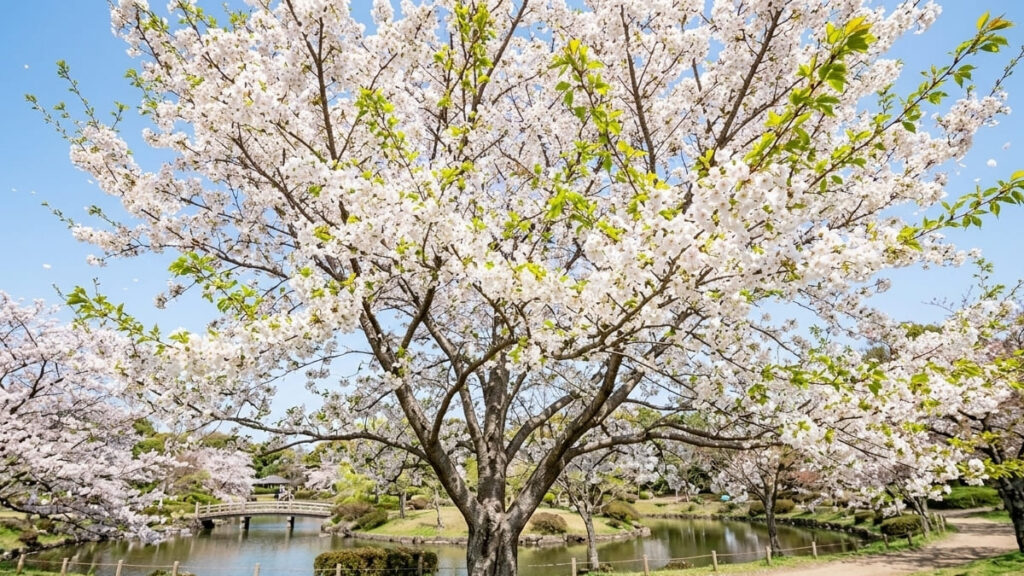
Sakura: The Heart of Spring

sakura - Beautiful Springtime Words with a Touch of Nostalgia

Within the vast vocabulary of Sakura (cherry blossoms), three particular expressions stand out. They describe not just the flowers themselves, but the subtle chemistry between the blossoms, the sky, and the light.

Hanagumori (Flower Haze)

This refers to the pale, pearly white sky often seen when the cherries are in full bloom.

While a crisp blue sky is beautiful, there is a unique gentleness to blossoms viewed under a milky, overcast veil. In this light, the boundaries between the petals and the air seem to melt away. In the cool, quiet air, one can appreciate the flowers without distraction. It is a humble, composed face of spring—one that feels quintessentially Japanese.

> There is a certain kindness in this soft light that you just don’t find on a piercingly sunny day.

Sakura-ame (Cherry Blossom Rain)

Rain falling during the peak of the bloom.

We often feel a pinch of regret when rain arrives just as the flowers open, but this word changes the scenery entirely. The rain-soaked petals become translucent and fragile, and the sight of fallen petals flowing along the ground creates a fleeting beauty that only exists in this moment.

> Though it feels a bit sad to see the petals fall, the rain brings its own magic. The wet bark of the trees turns dark and deep, making the contrast with the pale flowers even more breathtaking.

Hana-akari (Flower Light)

The phenomenon where a mass of cherry blossoms appears to glow with its own soft light, illuminating the darkness of night.

Even without a streetlamp, the area beneath a cherry tree feels dimly lit, as if the flowers themselves are exhaling a gentle radiance.

> It feels as though the moonlight has been caught by the petals, gathering there to guide us through the shadows.

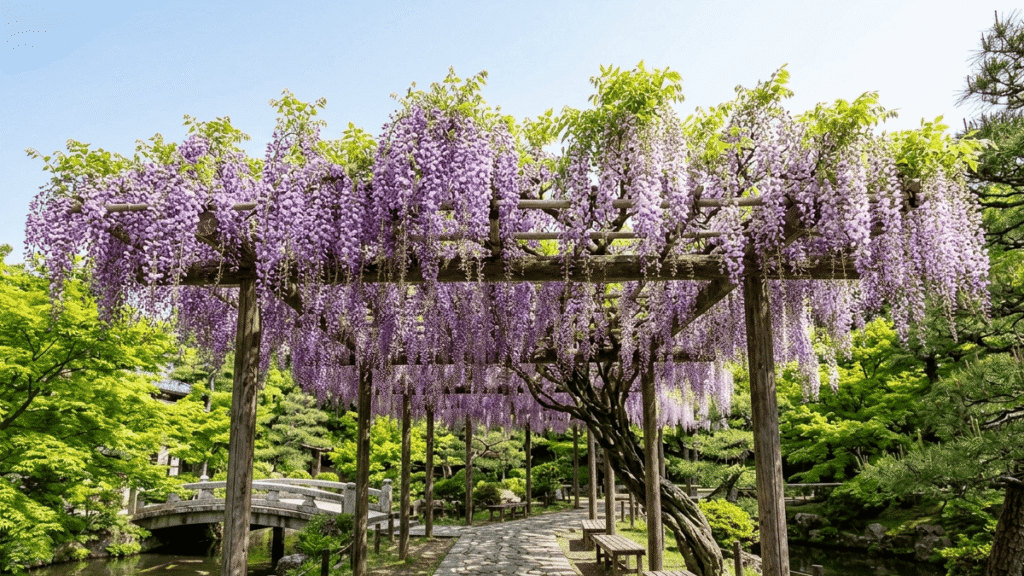
Fuji: The Heart of Spring

Fuji - Beautiful Springtime Words with a Touch of Nostalgia

I found a few beautiful expressions related to “Wisteria.” Out of those, I’d like to share two that really stuck with me.

“Sow the cotton seeds when the wisteria blooms” (Fuji no hana mite wata wo make)

This is an old Japanese agricultural proverb. It tells farmers that when the wisteria starts to bloom, it’s the perfect timing to sow cotton seeds.

Back in the day, wisteria trellises were often built right next to rice paddies or in spots overlooking the fields. Farmers would place them there so they could check the timing of their work at a glance. Those trellises also served as a cool, shaded spot to take a break—I can just imagine them enjoying their lunch under the flowers!

Also, the way long, lush wisteria clusters hang down was seen as a symbol of “heavy ears of rice.” Because of this, the flowers were used as an indicator to predict a bountiful harvest for the year!

Fujinami (Wisteria Waves)

This is a poetic term describing wisteria clusters swaying in the wind, looking just like rippling waves. It’s a compound word that has been loved in Waka (traditional Japanese poetry) since ancient times.

The white parts of the flowers give off this beautiful shimmer… it honestly looks so mystical, like you’re looking up from under the sea!

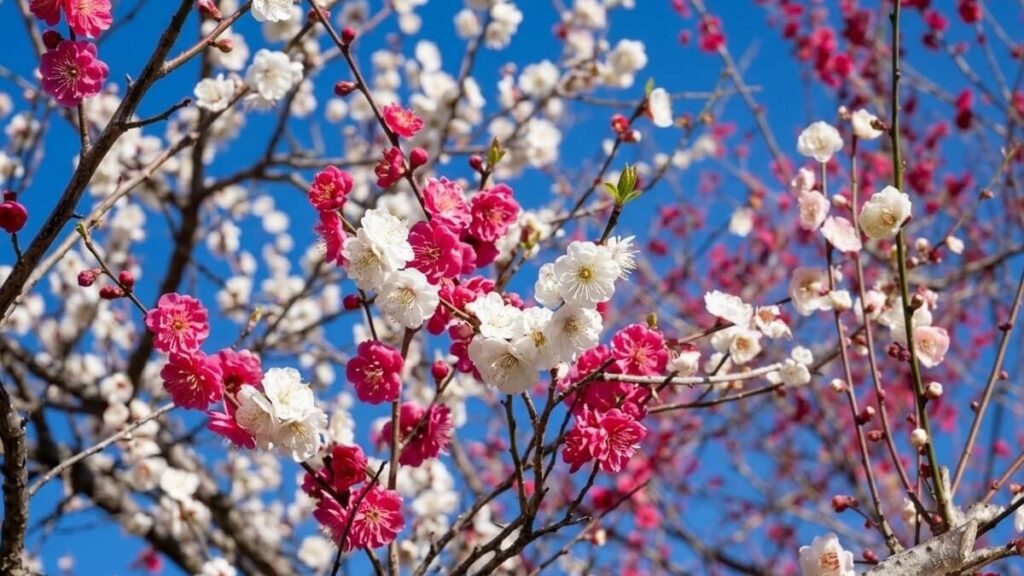
Ume (Plum Blossom)

ume - Beautiful Springtime Words with a Touch of Nostalgia

I came across several phrases related to “Ume.” Here are three that particularly left an impression on me.

Plum blossoms and nightingales

“Plum blossoms and nightingales” is synonymous with “good combinations.” In Edo-period senryu (humorous haiku), this is often followed by “bonito and mustard.”

Placing the elegant scenery with the common people’s food of the time—the first bonito of the season—is a typical Edo-style humor. At the time, eating bonito with mustard, which had a pungent kick, rather than the then-luxury wasabi, was considered the most sophisticated style. This phrase conveys the rich sensibilities of the Edo period, enjoying the aesthetics of spring and the flavors of the season together.

Plum blossoms are swelling

“Plum blossoms are swelling” is a seasonal expression that describes early spring (around February). It refers to the appearance of plum blossoms swelling and about to bloom.

“Fufumu” is an archaic form of “fukumu,” and describes the moment when the buds begin to open.

—Seeing the plum blossoms swelling instantly relieves tension and makes me look forward to spring. This is surely proof that I’m getting energy from “plum blossoms swelling” (Yay!).

Plum blossoms ward off misfortune for the day.

The power of plums is believed to help improve health and ward off illness. The ancient folk tale that “plums ward off evil” has been a part of ordinary people’s lives for centuries. Pickled plums seem to have become a common food item on ordinary people’s tables during the Edo period. It is said that the preparation method is almost the same as it is today.

The Journey of Shima-zushi: How Sea Breezes and Chili Peppers Shaped the Izu Islands’ Signature Preserve

Today, I want to delve into the story of Shima-zushi (Island Sushi).

Why this particular dish? Simply because I love the experience of it—tasting those bold flavors while gazing out at the vast ocean. Although, I must admit, it’s been quite a while since I last sat by the shore with a tray of sushi in hand…

When you lift a piece of Izu Island sushi to your lips, the sensation is different from what you might expect. Instead of the sharp, watery freshness of wasabi, you are met with the deep, grounding heat of karashi (Japanese mustard). Then there are the slices of fish themselves: they aren’t pale or translucent, but a lustrous, translucent amber. They have been bathed in a soy sauce infused with Shima-togarashi—small, fiery island chili peppers. (Seeing them shimmer in the light is enough to make anyone’s mouth water!)

But this style wasn’t chosen for aesthetics alone. It makes one wonder: in a place surrounded by the sea, how did this specific tradition of soy-marinated fish and chili come to be?

Why Shima-togarashi and Soy Sauce? Why not Salt or Wasabi?

Salt: An Island Nation with No Salt Underfoot

Japan is an archipelago surrounded entirely by the sea, yet the land itself holds no salt deposits deep within its soil. On the islands of the past, obtaining salt was a laborious cycle of boiling down vast amounts of seawater. This process “swallowed” incredible amounts of precious firewood—making salt a resource far too valuable for everyday preservation.

Within these environmental constraints, the islanders had to find another way to keep their fish from spoiling in the humid air. Their gaze turned toward shoyu (soy sauce) arriving from the mainland. This seasoned liquid became the essential vessel for preserving the ocean’s bounty, giving the fish a longer life and a deeper soul.

Chili Peppers: The Wild Spirit of Shima-togarashi

To the bottles of soy sauce, the islanders added these small, whole chili peppers. As the days passed, the heat slowly dissolved into the liquid, transforming a simple preservative into a vibrant, all-purpose seasoning with a sharp, fiery kick.

The Shima-togarashi (also known as the tree chili) originally hailed from the tropical regions of Central and South America. After being introduced to Japan during the Edo period, it didn’t just stay in the gardens where people planted it. It began to “grow on its own,” weaving itself into the wild landscape of the islands for a few fascinating reasons:

  • A Love for Humidity and Heat: The Izu Islands’ warm, rainy climate felt just like home to these peppers.
  • The “Tree” That Never Sleeps: In the colder parts of mainland Japan, chili plants are “annuals”—they wither and die when winter arrives. But on these islands, the winters are gentle. The plants don’t die; instead, they grow woody and tall like small trees (giving them the name Kidachi, or “standing tree”), bearing fruit for many years. Even without fertilizer, they grow vigorously along roadsides, in wastelands, and even near the salty spray of the coast.
  • Wandering Seeds: Interestingly, birds cannot feel the “heat” of chili peppers. They eat the bright red fruits and carry the seeds far away, dropping them across the island.

Compared to the common Takanotsume (Hawk’s Claw) chilies found elsewhere in Japan, the Shima-togarashi also has some delightful quirks in how it looks and grows!

A Tale of Two Chilies: Shima-togarashi vs. Standard Chili

While they may belong to the same family, these two peppers lead very different lives. Here is how the petite island chili stands apart from the common Takanotsume (Hawk’s Claw) found on the mainland.

FeatureStandard Chili (Takanotsume)Island Chili (Shima-togarashi)
SizeLong (approx. 5–7 cm)Petite (approx. 2–3 cm)
ShapeSlender with a pointed tipSmall, rounded, and bead-like
Growth HabitDownward: Hanging from the branchesUpward: Reaching toward the sky
Life CycleAnnual: Withers in the winterPerennial: Lives for years, becoming “woody”
Heat LevelA classic, bold kickSharp & Intense: 2 to 3 times hotter
AromaFamiliar, savory, and sharpFruity: Distinctly rich and aromatic
Main UsesCondiments, dried flakes, chili oilSoy infusions, Island Sushi, Kore-gusu

It is this unique, spirited aroma that gives Shima-zushi its incredible depth. Without the chili, the dish simply wouldn’t be the same!

What’s even more fascinating is that the flavor of the soy sauce changes depending on when the chilies are harvested. You can enjoy two distinct personalities from the same plant:

  • The Green Harvest (Unripe): When picked while still green, the infusion is defined by a crisp, “snappy” heat and a grassy freshness. In the Izu Islands, this version is often preferred for a style called Bekko—where the fish takes on a beautiful, translucent tortoiseshell glow.
  • The Red Harvest (Fully Ripe): As the chilies ripen to a brilliant red, they develop a natural sweetness and complexity. The soy sauce becomes mellow and deeply fruity, with a heat that feels rounded and warm.

Both sound absolutely delicious—and let’s be honest, they undoubtedly are!

The Canvas for the Flavor: Local Whitefish

The “Island Style” is to use whatever the sea offers at the peak of its season—specifically, firm yet fatty white-fleshed fish. Here are the stars that often find their way onto a Shima-zushi tray:

  1. Medai (Bluenose Warehou) — The King of Island Sushi
    • The Profile: Known for its soft, buttery texture and rich fat content.
    • The Pairing: The sweetness of the fat creates a perfect harmony with the spicy kick of the chili. It literally melts in your mouth, leaving a balanced, refined finish.
  2. Onagadai (Flame Snapper) — The Elegant Beauty
    • The Profile: A stunning, bright red fish with a clean, sophisticated flavor.
    • The Pairing: While delicate on its own, marinating it in island soy sauce adds a necessary “body” and depth to its light, elegant flesh.
  3. Shima-aji (Striped Jack) — The Island Treasure
    • The Profile: Famous throughout the Izu Islands for its distinctive “snap” (texture) and intense, savory umami.
    • The Pairing: The salt of the soy and the heat of the chili act as a spotlight, making the bold, natural flavors of the Shima-aji shine even brighter.
  4. Kanpachi & Hiramasa (Amberjack & Yellowtail) — The Robust Pair
    • The Profile: These fish have firm, meaty textures and a substantial amount of fat.
    • The Pairing: The marination process mellows the strong “blue fish” aroma, transforming it into a smooth, easy-to-eat delicacy with a satisfying bite.

A Few Seasonal Specialties…

  • Aodai (Blue Snapper): A summer favorite, especially around Hachijo-jima. Its flesh is beautifully translucent and pairs flawlessly with the amber glow of the soy sauce.
  • Tobiuo (Flying Fish): A sign of spring and summer. Though naturally lean, the marinade gives the flesh a wonderful, moist silkiness that is truly unique.

Can You Use Both Chili Soy Sauce and Karashi?

Is it possible to enjoy both the heat of the island chili and the sting of Japanese mustard at the same time? The answer is a resounding yes. In fact, the way Shima-zushi is served varies from island to island, home to home, and shop to shop. Here are the two main ways people embrace this “double heat”:

1. The Layered Style: Marinated in Chili, Topped with Karashi

  • The Method: First, the fish is “Zuke” (marinated) in soy sauce that has been aging with Shima-togarashi. Then, as the sushi is pressed, a small dab of karashi (Japanese mustard) is tucked secretly between the rice and the fish.
  • The Experience: The moment you take a bite, the fruity aroma and sharp, clean snap of the chili soy sauce spread across your palate. Just a second later, the deep, nasal sting of the mustard follows, “chasing” the first heat. For those who love a bit of fire, this is a luxurious, multi-dimensional experience.

2. The “Extra Kick” Style: A Finishing Dip

This style is common on islands like Hachijo-jima, where karashi is the standard condiment inside the sushi.

  • The Experience: The sushi itself is the classic “Fish + Mustard + Rice” build. However, the small side dish of soy sauce provided for dipping is already infused with Shima-togarashi. By dipping your sushi into this seasoned sauce, you are effectively blending the two worlds of heat in every mouthful.

A Harmony of Two Heats

You might wonder, “Do these two strong flavors fight each other?” Remarkably, they don’t. That’s because they offer two entirely different types of sensation:

  • Karashi: A sharp, volatile sting that travels through the nose.
  • Shima-togarashi: A direct, piercing heat (capsaicin) that dances on the tongue.

When these two meet, they don’t clash; instead, they work together to highlight the natural sweetness of fatty fish like Medai or Shima-aji. The result is a flavor that is incredibly bold, yet leaves your palate feeling surprisingly clean and refreshed. It is, quite simply, a masterpiece of balance!

Side Note: A Touch of Sweetness in the Rice

If you taste Shima-zushi, you may notice that the sushi rice (shari) is a bit sweeter than what you find in Tokyo. This is a reflection of the island’s warm climate and history. In the past, adding more sugar to the vinegar was a practical choice—it provided a quick energy boost for physical labor and helped preserve the rice in the humid heat.

This sweetness creates a rich, mellow foundation that perfectly offsets the fiery chili and the salt of the soy sauce. Interestingly, while the seasonings are local, the vinegar itself is typically standard rice or grain vinegar brought over from the mainland—a small but important link to the world beyond the horizon.

Closing Thoughts

Isn’t it fascinating how the simple act of “preserving fish” can vary so much from one island to the next? The next time you find yourself looking out at the Pacific, imagine the different flavors waiting for you on each shore. To help you plan your culinary journey, here is a quick guide to the two main styles of Shima-zushi.

Comparing Shima-zushi Styles: Hachijo-jima vs. Oshima & Toshima

FeatureHachijo-jima Style (The Standard)Oshima & Toshima Style (Bekko)
Common FishMedai, Shima-aji, Tobiuo, OnagadaiMedai, Budai (Parrotfish), Isaki, Tai
MarinadeA sweet and savory soy-based sauceSoy sauce infused with Shima-togarashi (Spicy)
CondimentKarashi (Japanese Mustard) is the standardGreen Chili (Dissolved in soy or minced)
AppearanceDeep amber, reminiscent of tortoiseshellA glossy, golden glow from the chili oil
Rice (Shari)Often noticeably sweetStandard sushi rice, or slightly sweet
HistoryMustard became the go-to substitute for wasabiA “local-first” approach using garden-grown chilies

Who Truly Claims the Volcano? The Story of Ashitaba: Japan’s Native “Tomorrow Leaf”

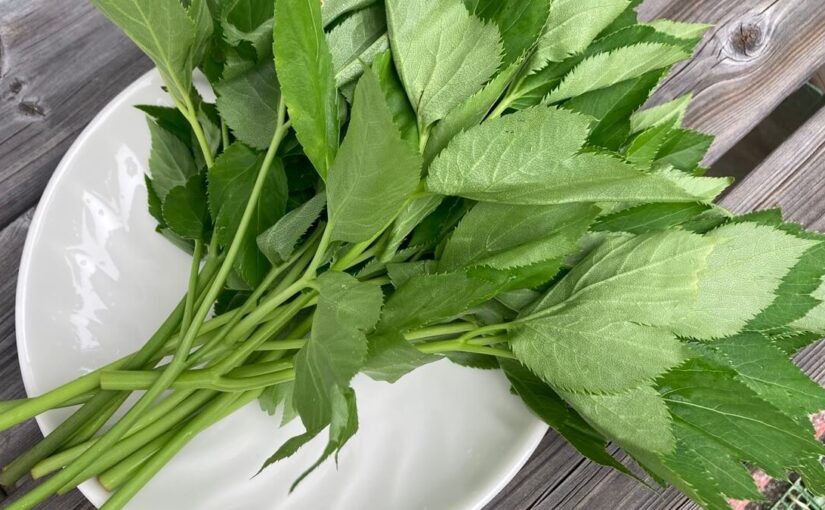
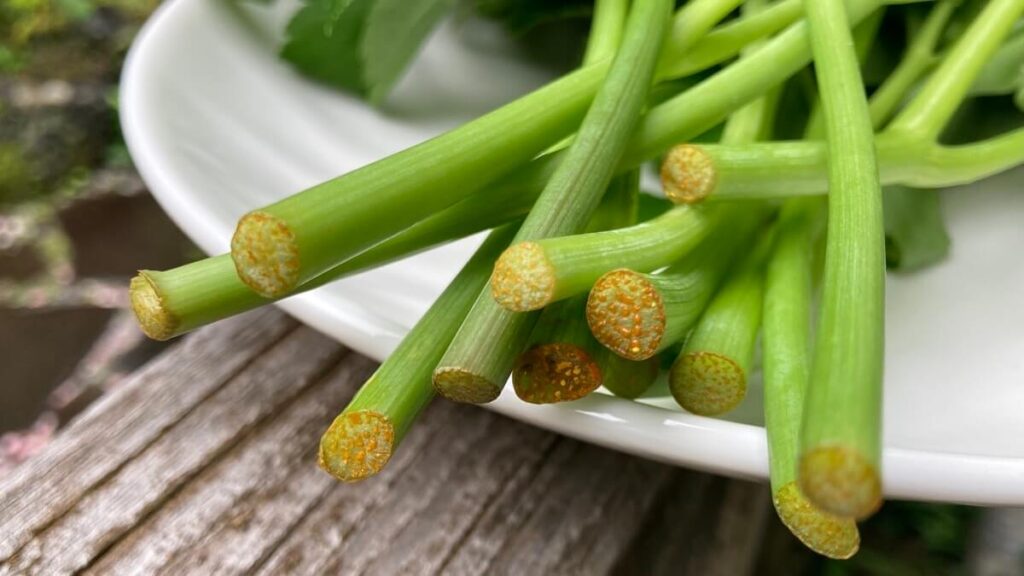
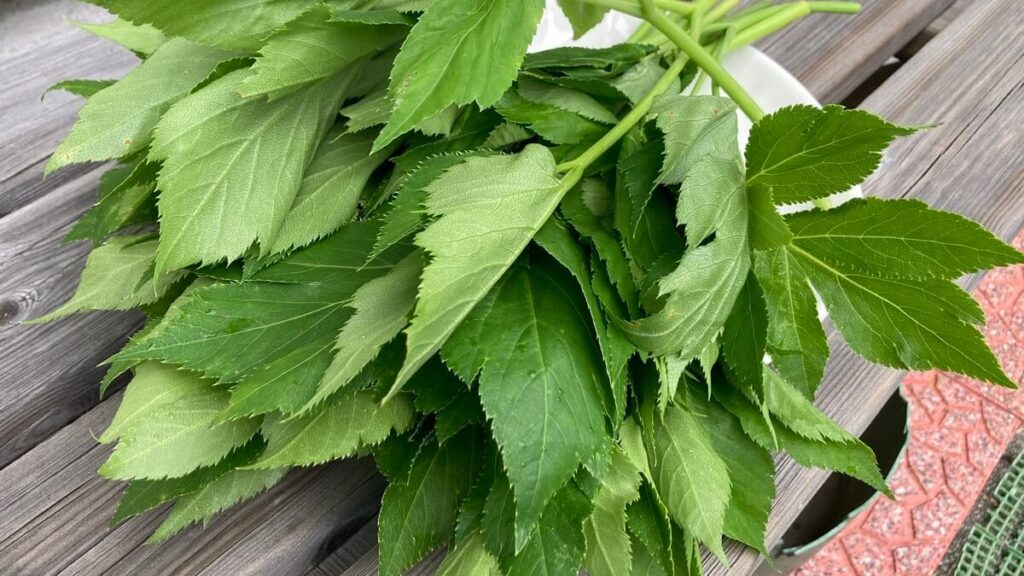
Today, I’d like to take a deeper look into Ashitaba (Angelica keiskei), a perennial herb from the carrot family that is native to Japan.You might wonder, why Ashitaba? For me, it comes down to a physical necessity. There is a specific kind of “wild” bitterness and astringency—what we call egumi in Japanese—found in these early spring greens. Taking that bitterness into my body feels like a vital ritual; it’s the spark that finally wakes my mind and limbs from their long winter slumber. Without it, I feel as though I’m still stuck in the cold, waiting for a spring that hasn’t quite arrived.The name “Ashitaba” literally translates to “Tomorrow’s Leaf.” There is an old saying that if you pick its leaves today, new buds will already be waiting for you by tomorrow. It’s a name that reflects an incredible, tireless vitality—as if the plant is inviting you to take what you need, knowing it has plenty more to give.

The Origin of the Name: A Vitality That Races Against Time

“Pick a leaf today, and a new bud appears tomorrow.”

This is the legend surrounding Ashitaba, a plant that thrives in the rugged, volcanic landscapes of the Izu Islands. Its name is a testament to its incredible pace of growth; it is said to possess such a fierce will to live that new shoots seem to burst forth almost as soon as the old ones are gathered.

You might find yourself wondering: “Wait, can it really grow back overnight?”

In truth, “tomorrow” is a bit of a poetic exaggeration. It generally takes anywhere from a few days to a week for a fresh leaf to fully unfurl. However, during its peak season, some records show that Ashitaba can grow more than 10 centimeters in a single day. In the world of plants, this is truly a “high-speed” evolution.

This rapid growth is more than just a quirk; it is a survival strategy honed by the harsh environment of volcanic islands. When an eruption leaves the land barren and stripped of green, Ashitaba is among the first to strike deep roots. It stretches upward, reaching for the sunlight faster than any other, reclaiming the desolate earth.

Back in the Edo period (1603–1867), people were so moved by this display of resilience that they treasured Ashitaba as a “medicinal herb of perpetual youth and longevity.” It was even chosen as a special gift to be presented to the Shogunate. Knowing that history makes every bite feel like a humble gift from the earth—one we should cherish deeply.

The Golden Sap: “Chalcone”
A Natural Nutrient Born of the Volcano

Who Truly Claims the Volcano? The Story of Ashitaba: Japan’s Native "Tomorrow Leaf"
"Chalcone"「Who Truly Claims the Volcano? The Story of Ashitaba: Japan’s Native "Tomorrow Leaf"」

When you harvest Ashitaba, a thick, sticky yellow sap slowly seeps from the cut end of the stem. This isn’t just moisture; it is the very essence of the plant’s resilience. Known as “Chalcone” (specifically xanthoangelol and related compounds), this golden liquid is often called the “source of its life force.”

What makes Chalcone truly remarkable is its rarity. It is almost never found in other plants; it is a nutrient that belongs uniquely to Ashitaba—a “patent” of sorts, granted by nature only to this particular species.

Potential BenefitsHow It WorksWhy It Matters
Inner Flow SupportPromotes smooth circulation and helps the body flush out excess water and waste.A powerful ally for detox and reducing puffiness.
Age-Defying PowerPotent antioxidant properties protect cells from environmental damage.Supports youthful vitality and anti-aging.
Natural BarrierContains antibacterial compounds the plant uses to shield itself from insects and microbes.Strengthens your wellness and natural defenses against external stressors.

In the past, the people living on these rugged volcanic islands turned to this golden sap as a form of traditional medicine. They would apply it to wounds to aid healing or consume it as a powerful tonic to restore vitality.

A word of caution, though: true to its medicinal strength, that golden Chalcone is incredibly stubborn! If it gets on your skin or clothes while harvesting, it won’t wash off easily. Of course, the “richness” of the sap varies depending on the specific soil it grew in and the season it was picked—nature never produces the exact same thing twice. If you ever have the chance, I encourage you to try and taste the subtle differences for yourself.

The Strongest Ashitaba Grows on Miyakejima Island

While the golden sap known as Chalcone is remarkable, it is the volcanic ash soil of Miyakejima that truly nurtures it to its peak. At first glance, the scorched earth of a volcano might seem inhospitable, but for Ashitaba, this is its “ideal landscape.”

Here are the three reasons why:

1. Breathable Earth: The Ultimate Drainage

When a volcano erupts, it leaves behind layers of scoria—porous, coarse volcanic ash filled with tiny air pockets. This creates exceptional drainage. Since Ashitaba dislikes stagnant moisture and needs its roots to “breathe” deeply, this airy, loose soil is where the plant feels most at ease.

2. Minerals from the Deep: Earth’s Raw Energy

The energy of the volcano delivers fresh nutrients from deep underground. The young soil born from magma is rich in essential minerals like iron and manganese. The robust flavor and potent nutrition of Miyakejima’s Ashitaba are proof that it is drinking deeply from this raw, elemental wealth.

3. Resilience Born from Hardship

There is a paradoxical side to volcanic soil: because it is so porous, nutrients can wash away easily. This “slightly tough” environment triggers a survival instinct in the plant. To protect itself from these lean conditions, Ashitaba concentrates its strength, producing an even richer, thicker flow of that golden Chalcone.

Ways to Serve Ashitaba

  • Fresh & Simple: Yes, you can eat it raw! Stick to the tender tips and young stems for the best texture.
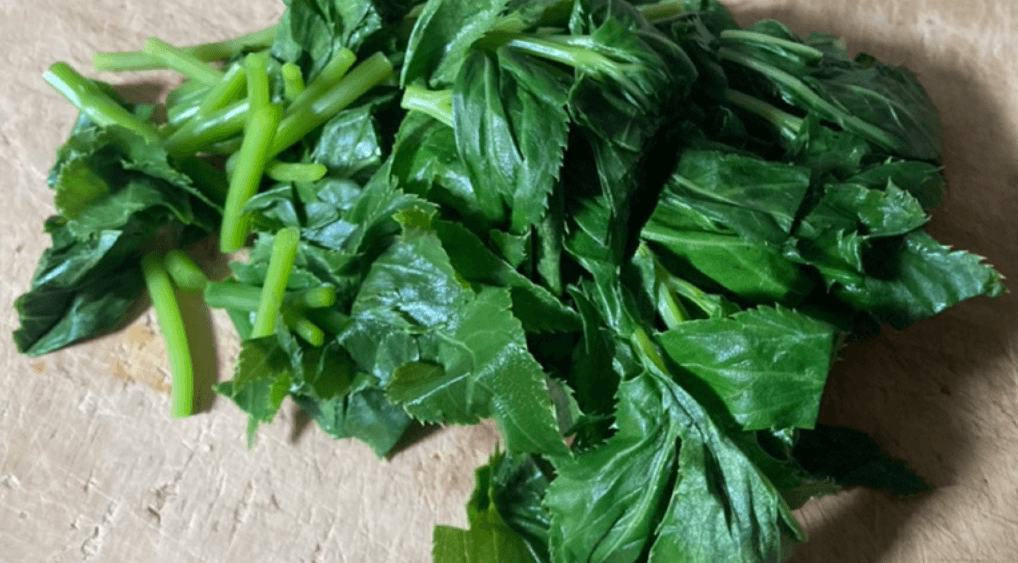
  • The “Quick Blanch” Method: A quick dip in salted boiling water followed by a cold rinse makes the color pop! Squeeze well and add your go-to dressing. It’s the perfect healthy side dish.
  • Sauteed or Fried: Ashitaba loves oil! Frying or stir-frying brings out a wonderfully mellow flavor. Tempura Ashitaba is a must-try!
Who Truly Claims the Volcano? The Story of Ashitaba: Japan’s Native "Tomorrow Leaf"
The “Quick Blanch” Method

【A Side Note】The Akakokko’s Favorite Spot

The Akakokko (Izu Thrush) is a symbolic bird of Miyakejima and a designated National Natural Monument of Japan. Interestingly, these birds are also great fans of the Ashitaba fields.

Because the volcanic soil is so well-maintained for growing Ashitaba, the fields offer an open, clear view of the ground. For the Akakokko, who love to hop along the earth in search of food, these fields are the perfect, most comfortable “outdoor dining spots” on the island.

Closing Thoughts

I hope you enjoyed this journey into the world of Ashitaba.

Through the lens of this remarkable plant, we can see how the fire of the volcano and the resilience of life are so beautifully intertwined.

May you find your own way to enjoy the vibrant energy of the “Tomorrow Leaf.”

ItemDetailsNotes
Common NameAshitabaAlso known as Hachijo-so (Hachijo Grass).
ClassificationApiaceae Family (Angelica genus)Related to parsley, celery, and cilantro; shares their aromatic qualities.
Main OriginsIzu Islands (Miyakejima, Hachijojima, etc.)Thrives naturally and is cultivated in rich volcanic ash soil.
Best SeasonFebruary to May (Spring)The young shoots are at their softest and most flavorful.
Key FeatureThe Golden Sap: “Chalcone”A rare, yellow liquid that seeps from the stem when cut.
Flavor ProfileA distinct bitterness and refreshing aromaWhen fried as tempura, the bitterness mellows and becomes quite savory.
Flower Language“Vibrant Vitality”A symbol of the “Tomorrow Leaf” that never stops growing.
Who Truly Claims the Volcano? The Story of Ashitaba: Japan’s Native "Tomorrow Leaf"

Oshima Cherry (Oshima-zakura): The Wild Species of the Izu Islands That Turns Volcanic Wasteland into Fertile Soil

Today, I’d like to take a deep dive into the Oshima Cherry (Oshima-zakura).

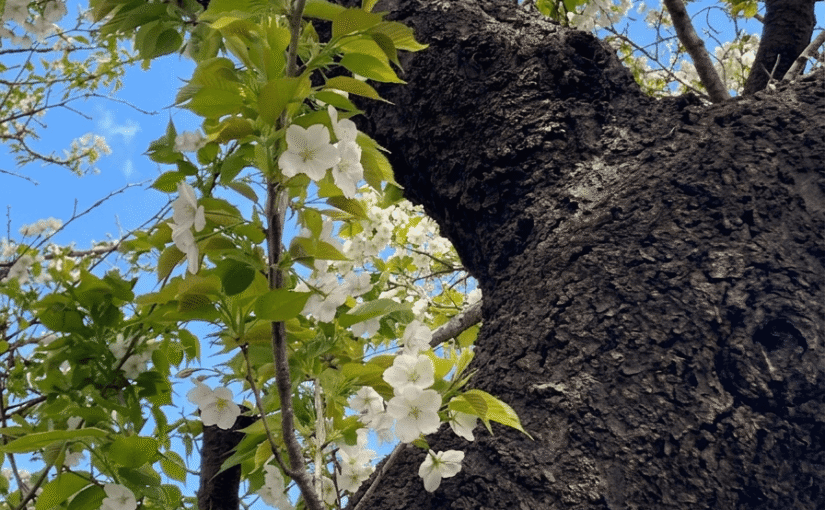
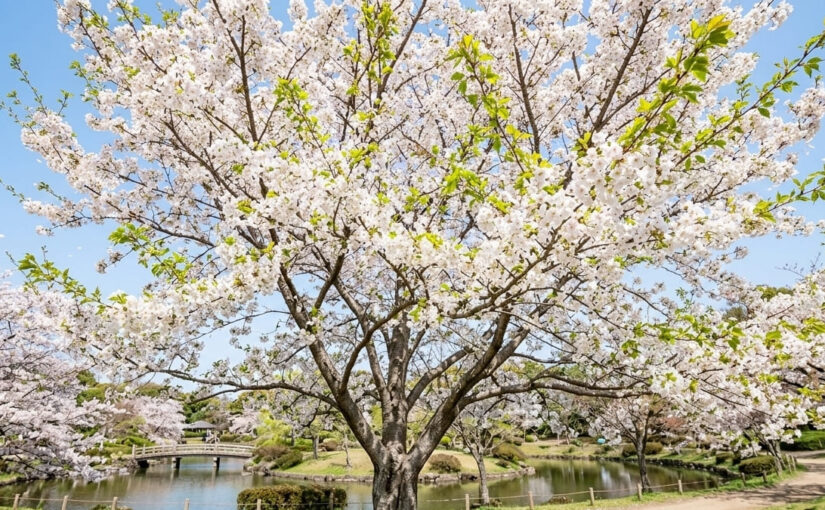
Why this specific tree? To be honest, I’ve always been captivated by the way its blossoms and fresh young leaves emerge at the very same time—a beautiful harmony of crisp white and vibrant green. There is also something deeply satisfying about its bark; in younger trees and established adults, the trunk carries a subtle, polished luster that catches the eye.

And, of course, I cannot talk about this tree without mentioning Sakura-mochi. That iconic Japanese rice cake, wrapped in a salted cherry leaf, owes its unmistakable aroma and unique texture to the Oshima Cherry. For many of us, the soul of this sweet treat lies right there in the leaf.

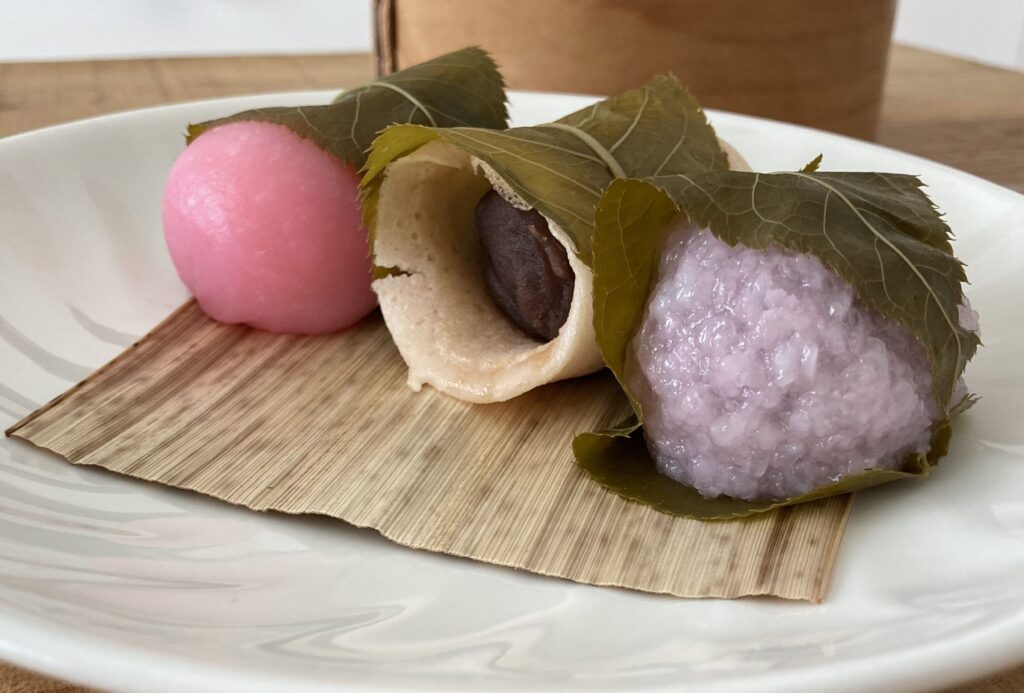
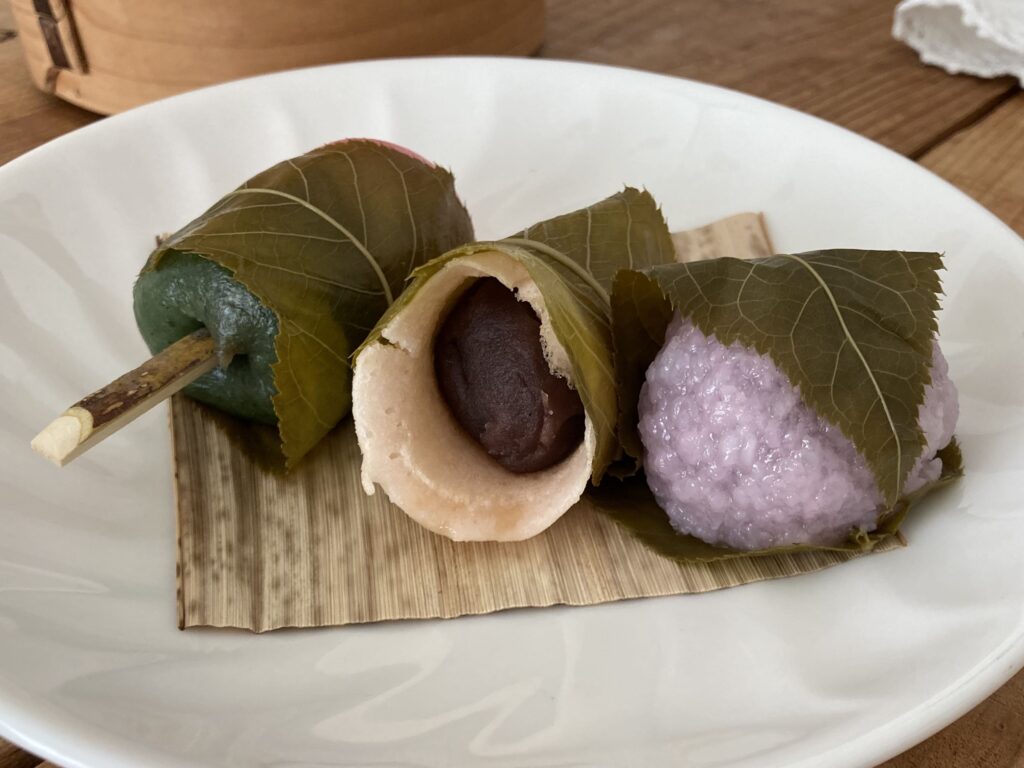
Sakuramochi. Domyoji / Oshima Cherry: The Wild Species of the Izu Islands That Turns Volcanic Wasteland into Fertile Soil
From left to right: Sakuradango, Sakuramochi. Domyoji

More Than Just a Fragrant Wrap: The True Identity of the Oshima Cherry

Think of that rich, sweet aroma that comes with every bite of Sakura-mochi. The large, fragrant leaf wrapping the rice cake is, in fact, the leaf of the Oshima Cherry. But its “greatness” goes far beyond just being delicious.

In the volcanic regions of the Izu Islands, this tree is known as a “pioneer.” Even in harsh, desolate landscapes covered in cooled lava, it is among the first to take root. It doesn’t just survive; it actively reshapes the environment around it.

So, what is the secret strategy of the Oshima Cherry? How does it face the rugged ground beneath its feet and turn it into something new? Let’s explore its remarkable survival strategy.

Starting from the Lava: A Survival Strategy as a Pioneer Species

The homeland of the Oshima Cherry is the volcanic landscape of the Izu Islands. Looking at the polished, elegant bark of the younger trees or the succulent green leaves that sprout in early spring, it’s almost hard to imagine such a rugged origin.

This tree is a wild species native to Japan, growing naturally along the coasts of the Izu Islands and the southern Kanto region. In fact, it gets its name from the island of Izu Oshima, where it has flourished for centuries.

Broadly speaking, these volcanic islands fall into two categories: “black” islands made of basalt and “white” islands made of rhyolite. Izu Oshima, the namesake of our cherry tree, is the “black” type—a landscape forged from dark, volcanic rock.

Volcanic Island Types: A Comparison

CharacteristicsBasaltic Islands (The Black Islands)Rhyolitic Islands (The White Islands)
Primary IslandsIzu Oshima, Miyakejima, HachijojimaNiijima, Shikinejima, Kozushima
Magma NatureLow viscosity (Runny and fluid)High viscosity (Thick and sticky)
LandscapesGentle slopes; stratovolcanoesDome-shaped mountains; sharp cliffs
Ground & SandDark/Black (Volcanic ash, scoria)Pure White (Koga-seki stone, volcanic glass)
Key SpotsMt. Mihara, Ura-sabaku (Izu Oshima)Shiro-mama Cliffs (Niijima)

In places so harsh that most plants would give up before even trying, the Oshima Cherry is the first to sprout. It all begins with a single seed carried by a bird—our essential little messenger. From that tiny seed, the tree twists its roots into narrow cracks in the rock and stretches toward the sun faster than anyone else.

And it’s not just the lack of nutrients they face. They also endure the relentless salt winds blowing off the sea and the extreme dryness of the scorching sun. Yet, for the Oshima Cherry, all of this seems to be “exactly as expected.”

This toughness, forged in such a brutal environment, is precisely why this tree was chosen as the ancestor for so many cultivated varieties, including the famous Somei-yoshino.

Knowing this history, the dignified presence of the tree and even the unique flavor of its leaves suddenly make perfect sense. It is a beauty and a taste earned through survival.


Creating Life from Within: The Strategy to Enrich the Soil

The leaves of the Oshima Cherry are notably larger and thicker than those of other cherry varieties. It makes perfect sense why these specific leaves were chosen to wrap Sakura-mochi—it’s all thanks to their ideal size and sturdiness. But this “large leaf” holds a hidden, vital strategy for survival…

Falling Leaves as Natural Fertilizer

Come autumn, these large leaves dance down to the ground all at once. Covering the earth in a thick layer, the fallen leaves act like a “blanket,” protecting the soil from the winter cold and dryness. Then, tiny microbes—some hiding in the cracks of the lava, others carried by the wind or birds—begin to break down these leaves, transforming them into rich, fertile humus. We really owe it all to these hardworking microbes!

Life Even on Bare Lava!

At first glance, cooled lava looks devoid of life. However, it’s actually home to resilient organisms like lichens and specialized rock-dwelling bacteria. They slowly wear away the rock surface, dissolving and releasing minerals.

When the large leaves of the Oshima Cherry pile up on top, they become a “home” for these microbes:

  • Moisture: Lava dries out quickly, but a layer of leaves traps vital water beneath.
  • Food: The fallen leaves provide the ultimate source of nutrients.

With a cozy home and plenty of food, the microbes begin to multiply rapidly, cheering, “We can live here!”

As they consume the leaves, the decomposed organic matter mixes with the tiny particles of eroded lava. This mixture becomes the “first millimeter of soil”—the very foundation that, centuries later, will support a deep, lush forest. Just one millimeter! It sounds so small, but when you imagine it spreading across the entire landscape… it’s quite a feat, isn’t it?

In a barren land of lava where no nutrients exist, the Oshima Cherry collaborates with microbes through its fallen leaves to create a self-sustaining cycle. Slowly but surely, the hard ground softens, transforming into the rich, “fluffy” soil that life needs to thrive. Truly, cooperation is the key to everything.

Roots as “Nature’s Cultivators”: The Power to Pierce Through Rock

To survive in the desolate, nutrient-poor lava fields, the roots of the Oshima Cherry are incredibly powerful. When they find even the tiniest crack in the rock, they wedge themselves in, thickening with such force that they can actually split the stone apart. This “root power” creates gaps in the rock, opening up “paths” for air and water to flow through the once-solid ground.

A Natural “Soil Anchor” and Hidden Network

Their roots don’t just dive deep; they also spread wide like a sprawling net. This acts as a natural anchor, firmly gripping the earth to prevent landslides and stop the precious topsoil from being washed away by wind and rain. In the harsh environment of an island, the tree isn’t just securing its own spot—it’s also playing a humble yet vital role in protecting the island itself.

Where these trees have taken root, tilled the soil, and created space, other trees and wildflowers eventually find a place to grow. The “underground paths” carved by the Oshima Cherry become a lifeline for other species. This network serves as the “infrastructure” that will support a lush, thriving forest hundreds of years from now. All of this, starting from a single fallen leaf… it’s truly remarkable.

I am deeply moved by this brilliant strategy (whether by chance or a shared purpose). Exploring the story of the Oshima Cherry has been a truly eye-opening journey.

Oshima-zakura: The Wild Soul of Japan’s Cherry Blossoms

“Today, I would like to explore the close, long-standing relationship between the Oshima-zakura—the Oshima Cherry tree—and the way of life in Japan. It is a tree that is familiar to many, yet its deeper role in our daily lives often goes unnoticed.”

Oshima Cherry: The Wild Species of the Izu Islands That Turns Volcanic Wasteland into Fertile Soil

Hello there.
Let me introduce myself.
My name is Oshima-zakura.

You might know my famous son, the Somei-yoshino—the pale pink star of Japan’s cherry blossom season. I am his father, a wild, native cherry tree born and raised in the rugged beauty of the Izu Islands.

Today, I’d like to take you on a little journey into the deep, quiet bond I’ve shared with the Japanese people for centuries. It’s a story woven into the very fabric of their daily lives—what they wear, what they eat, and how they live.

My home is Izu Oshima and the surrounding islands, where my kin still grow wild and free. That’s why they call me “Oshima.”

Have you ever tried Sakura-mochi? That sweet, pink rice cake wrapped in a salty leaf that tastes like spring? That nostalgic, elegant scent that drifts from the treat… that’s actually me. My leaves hold a special fragrance that comes to life when they are preserved, bringing the essence of the forest to the tea table.

Since ancient times, I have lived alongside the people of the coast and the islands, supporting them in ways seen and unseen. I am more than just a pretty flower; I am a part of the Japanese landscape and the spirit of the seasons.

When was it first discovered?

There is no specific year or person credited with my discovery.
Record shows that I have been known to the Japanese people since ancient times; my name even appears in writings from the Heian period (8th to 12th century).

“That long ago?” you might wonder.
The reason I have been around so long is simple: I am incredibly resilient.

My home, Izu Oshima, is a volcanic island that has endured many violent eruptions. While many other plants vanished under the ash, I survived. To see this resilience for yourself, you only need to look at the “Sakura-kabu” on Izu Oshima—a great elder of my kind, estimated to be over 800 years old.

For centuries, I have been a part of the local way of life. Because I bloom with such large, pure white flowers, people once looked to me as a sign that the “God of the Rice Fields” had arrived. In the harsh environment of the islands, I was more than just a tree; I was a vital landmark that connected the people’s hard work with the changing seasons.

Fuel, Tools, and Art

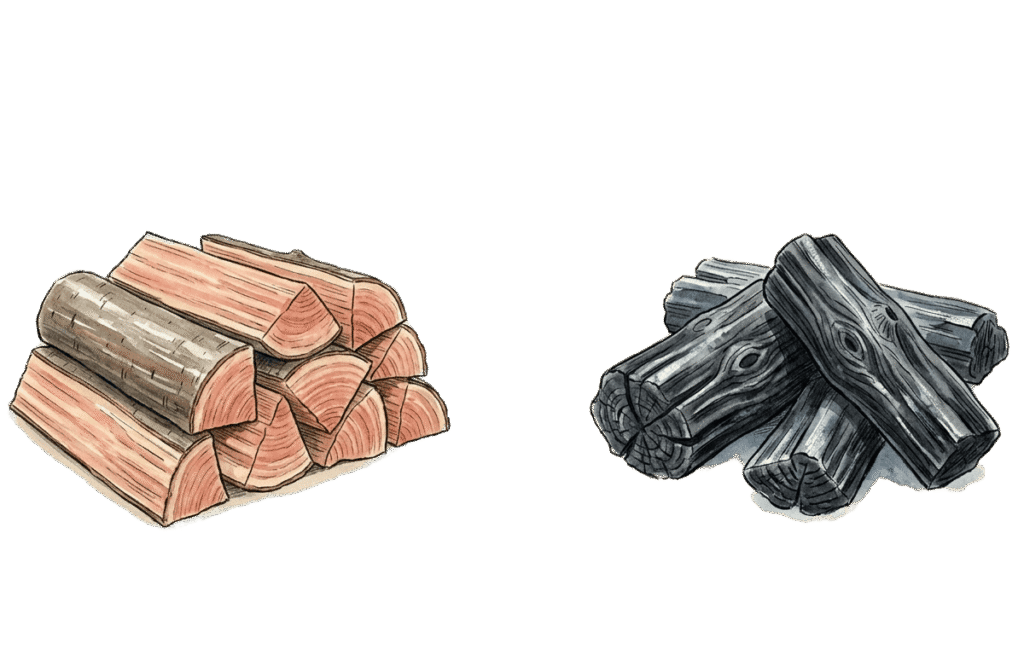
As time passed, my ability to sprout quickly and grow strong—even in harsh environments—made me a vital resource for the islanders. My wood provided excellent “Maki” (firewood) and “Sumi” (charcoal). Because it burns with high heat, it became a reliable energy source, supporting the “Ju” (housing and shelter) needed to survive cold winters.

Fuel, Tools, and Art: Oshima-zakura: The Wild Soul of Japan’s Cherry Blossoms

The wood of a “wild species” like myself is naturally dense and durable. It is resistant to decay and stands up well to water, which is why it was often chosen for kitchen essentials like “Mana-ita” (cutting boards) and “Shamoji” (rice paddles). I was a practical partner in the heart of the home.

During the Edo period, when Ukiyo-e woodblock prints reached their height, my wood was selected for the “Hangi” (printing blocks) used to carve intricate lines. Because my grain is fine and hard, I became deeply involved in the development of Japanese art and culture.

Dyes, Crafts, and the Essence of “Sakura-iro”

My wood is not only hard and durable; it also holds within its branches and bark the very “Sakura-iro” (cherry blossom pink) that people envision.

The brightest colors appear just before the bloom

Have you ever heard of “Kusaki-zome” (natural plant dyeing)?
By simmering finely chopped branches, you can dye fabric into a beautiful pink. Curiously, the most vibrant colors are extracted right before the flowers bloom, when the energy is concentrated in the buds. It is said that the nobility of the Heian period (8th–12th century) captured these seasonal colors in their clothing, literally “wearing the seasons.”

The deepening glow of the bark

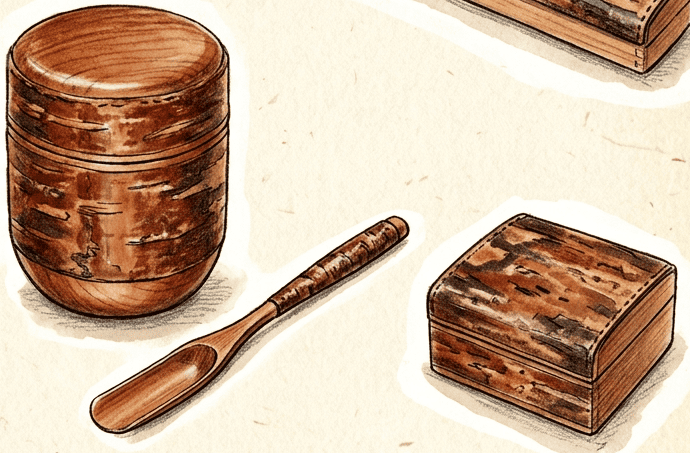
My bark is remarkably strong and has a unique natural luster. This quality has long been cherished in traditional crafts, such as Akita’s “Kaba-zaiku” (wild cherry bark work), where it is used as a primary material alongside other wild cherries.

The deepening glow of the bark: The Wild Soul of Japan’s Cherry Blossoms

The bark is also resistant to water. With use over time, its color shifts from a reddish-brown to a deep, polished amber, gaining a richer glow. Because of this, it was used to decorate the personal items of both samurai and townspeople—from “Inro” (small portable cases) and tea caddies to the scabbards of swords—adding a sense of “Iki” (a refined, understated stylishness) to their belongings.

By the Edo period, “Sakura-iro” became a color of longing for common people as well, serving as a source of beauty that added both brilliance and dignity to their attire.

Sakuramochi

Sakuramochi|Oshima-zakura: The Wild Soul of Japan’s Cherry Blossoms
From left to right: Sakuradango, Sakuramochi. Domyoji

Now, let us look at how I became a part of Japan’s food culture. My rise to fame in the city of Edo (modern-day Tokyo) began in 1717. At a temple called Chomeji in the Mukojima district, a gatekeeper named Shinroku Yamamoto noticed the vast amount of my fallen leaves along the banks of the Sumida River. Thinking it was a waste to let them simply wither, he decided to find a use for them.

He experimented by pickling the leaves in salt and wrapping them around mochi (rice cakes). This was the birth of “Chomeji Sakuramochi.” It became an instant sensation among the people of Edo for its refined fragrance and unique taste.

Why must it be the Oshima-zakura leaf?

It is often said that this specific flavor cannot be achieved with leaves from other cherry trees. There are three physical reasons for this:

  1. Coumarin, the sweet scent: When my leaves are pickled in salt, a fragrant compound called “Coumarin” is released. It has a sweet, vanilla-like aroma, and my leaves contain a significantly higher concentration of it than other species.
  2. Smooth, hairless texture: Unlike many other cherry leaves, mine are smooth and lack fine hairs. This makes them pleasant to the touch and provides a smooth texture when eaten with the mochi.
  3. Size: My leaves grow large at the same time the flowers bloom. This size is ideal for gently and securely wrapping the rice cake.

Nishi-Izu: The heart of leaf production

To this day, the leading producer of my leaves is the Nishi-Izu region (such as Matsuzaki) in Shizuoka Prefecture.
The harvest begins in May, and the leaves are pickled in large wooden barrels for about six months. This careful aging process draws out the signature aroma, finally reaching people the following spring. It is a taste of the season, crafted through half a year of patient maturation.

In Closing

I hope this has given you a new perspective on the Oshima-zakura.

While it is a tree that can be found in many places, its history and its deep connection to the Japanese way of life are often quiet and hidden. Next time you are out for a walk, I hope you take a moment to look for its large white blossoms or its smooth, fragrant leaves, and feel the presence of this native cherry tree for yourself.

Profile: Oshima-zakura

ItemDescription
Common NameOshima-zakura (Oshima Cherry)
Scientific NameCerasus speciosa
ClassificationRosaceae, Genus Cerasus (Wild species native to Japan)
Main HabitatIzu Islands, Izu Peninsula, Boso Peninsula, Miura Peninsula, etc.
Growth RateVery fast
Blooming SeasonLate March to early April (Around the same time as Somei-yoshino)
Flower FeaturesLarge, pure white single-petaled flowers. Green leaves appear at the same time as the blooms.
Fruiting SeasonMay to June (Ripens to a deep blackish-purple)
Wood CharacteristicsDense, very hard, and resistant to wear. Durable against decay and easy to process.
Fragrant CompoundCoumarin (The scent becomes strong when leaves are pickled in salt)
Visiting BirdsWarbling White-eye, Japanese Tit, Brown-eared Bulbul, Izu Thrush (Akakokko), etc.
Main UsesLeaves for Sakuramochi, firewood/charcoal, construction, furniture, woodblock printing, natural dyeing.