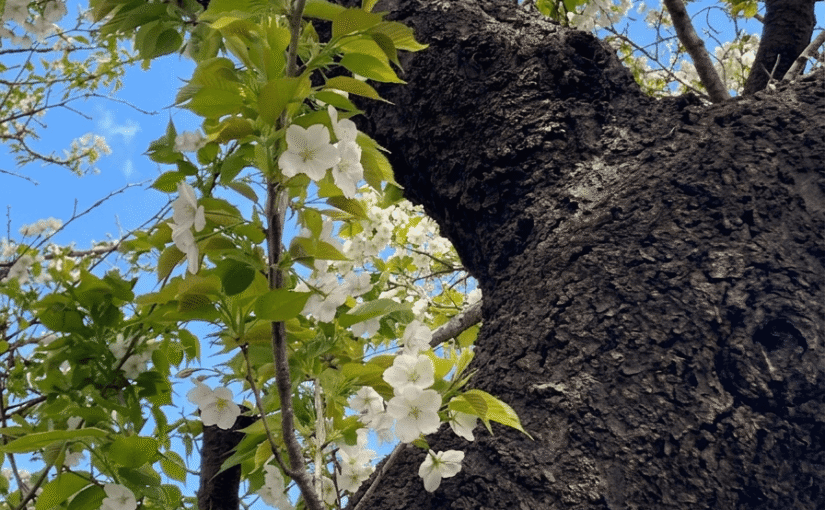
“Today, I would like to explore the close, long-standing relationship between the Oshima-zakura—the Oshima Cherry tree—and the way of life in Japan. It is a tree that is familiar to many, yet its deeper role in our daily lives often goes unnoticed.”
Hello there.
Let me introduce myself.
My name is Oshima-zakura.
You might know my famous son, the Somei-yoshino—the pale pink star of Japan’s cherry blossom season. I am his father, a wild, native cherry tree born and raised in the rugged beauty of the Izu Islands.
Today, I’d like to take you on a little journey into the deep, quiet bond I’ve shared with the Japanese people for centuries. It’s a story woven into the very fabric of their daily lives—what they wear, what they eat, and how they live.
My home is Izu Oshima and the surrounding islands, where my kin still grow wild and free. That’s why they call me “Oshima.”
Have you ever tried Sakura-mochi? That sweet, pink rice cake wrapped in a salty leaf that tastes like spring? That nostalgic, elegant scent that drifts from the treat… that’s actually me. My leaves hold a special fragrance that comes to life when they are preserved, bringing the essence of the forest to the tea table.
Since ancient times, I have lived alongside the people of the coast and the islands, supporting them in ways seen and unseen. I am more than just a pretty flower; I am a part of the Japanese landscape and the spirit of the seasons.
When was it first discovered?
There is no specific year or person credited with my discovery.
Record shows that I have been known to the Japanese people since ancient times; my name even appears in writings from the Heian period (8th to 12th century).
“That long ago?” you might wonder.
The reason I have been around so long is simple: I am incredibly resilient.
My home, Izu Oshima, is a volcanic island that has endured many violent eruptions. While many other plants vanished under the ash, I survived. To see this resilience for yourself, you only need to look at the “Sakura-kabu” on Izu Oshima—a great elder of my kind, estimated to be over 800 years old.
For centuries, I have been a part of the local way of life. Because I bloom with such large, pure white flowers, people once looked to me as a sign that the “God of the Rice Fields” had arrived. In the harsh environment of the islands, I was more than just a tree; I was a vital landmark that connected the people’s hard work with the changing seasons.
Fuel, Tools, and Art
As time passed, my ability to sprout quickly and grow strong—even in harsh environments—made me a vital resource for the islanders. My wood provided excellent “Maki” (firewood) and “Sumi” (charcoal). Because it burns with high heat, it became a reliable energy source, supporting the “Ju” (housing and shelter) needed to survive cold winters.
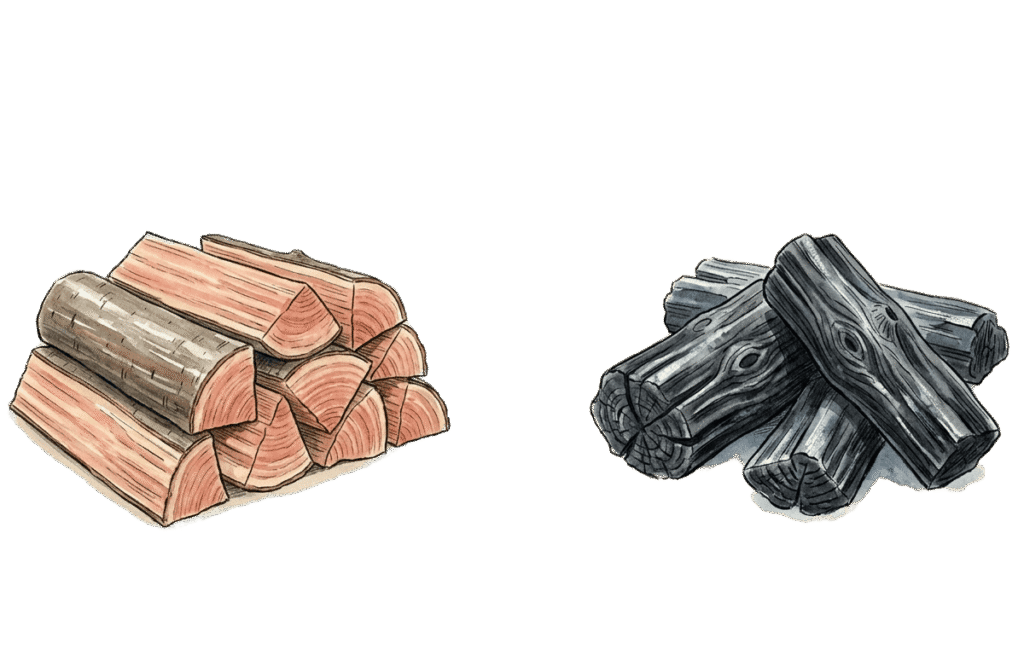
The wood of a “wild species” like myself is naturally dense and durable. It is resistant to decay and stands up well to water, which is why it was often chosen for kitchen essentials like “Mana-ita” (cutting boards) and “Shamoji” (rice paddles). I was a practical partner in the heart of the home.
During the Edo period, when Ukiyo-e woodblock prints reached their height, my wood was selected for the “Hangi” (printing blocks) used to carve intricate lines. Because my grain is fine and hard, I became deeply involved in the development of Japanese art and culture.
Dyes, Crafts, and the Essence of “Sakura-iro”
My wood is not only hard and durable; it also holds within its branches and bark the very “Sakura-iro” (cherry blossom pink) that people envision.
The brightest colors appear just before the bloom
Have you ever heard of “Kusaki-zome” (natural plant dyeing)?
By simmering finely chopped branches, you can dye fabric into a beautiful pink. Curiously, the most vibrant colors are extracted right before the flowers bloom, when the energy is concentrated in the buds. It is said that the nobility of the Heian period (8th–12th century) captured these seasonal colors in their clothing, literally “wearing the seasons.”
The deepening glow of the bark
My bark is remarkably strong and has a unique natural luster. This quality has long been cherished in traditional crafts, such as Akita’s “Kaba-zaiku” (wild cherry bark work), where it is used as a primary material alongside other wild cherries.
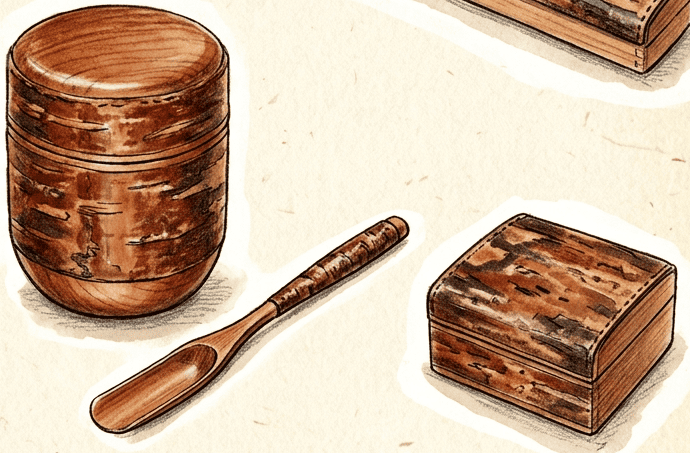
The bark is also resistant to water. With use over time, its color shifts from a reddish-brown to a deep, polished amber, gaining a richer glow. Because of this, it was used to decorate the personal items of both samurai and townspeople—from “Inro” (small portable cases) and tea caddies to the scabbards of swords—adding a sense of “Iki” (a refined, understated stylishness) to their belongings.
By the Edo period, “Sakura-iro” became a color of longing for common people as well, serving as a source of beauty that added both brilliance and dignity to their attire.
Sakuramochi
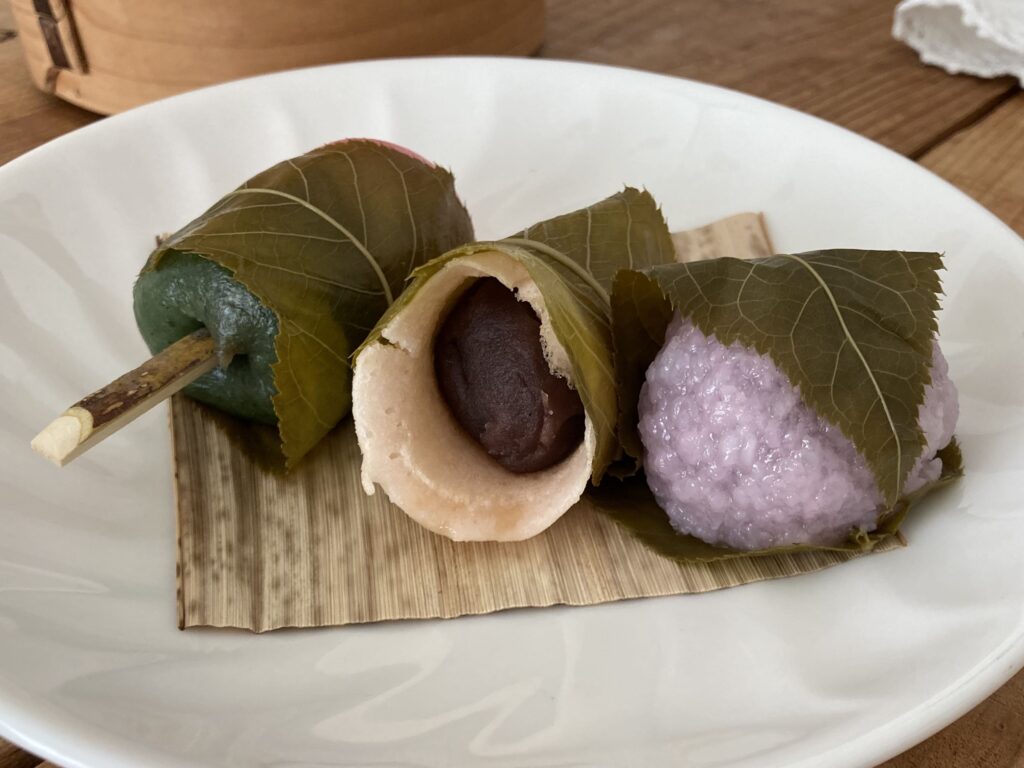
From left to right: Sakuradango, Sakuramochi. DomyojiNow, let us look at how I became a part of Japan’s food culture. My rise to fame in the city of Edo (modern-day Tokyo) began in 1717. At a temple called Chomeji in the Mukojima district, a gatekeeper named Shinroku Yamamoto noticed the vast amount of my fallen leaves along the banks of the Sumida River. Thinking it was a waste to let them simply wither, he decided to find a use for them.
He experimented by pickling the leaves in salt and wrapping them around mochi (rice cakes). This was the birth of “Chomeji Sakuramochi.” It became an instant sensation among the people of Edo for its refined fragrance and unique taste.
Why must it be the Oshima-zakura leaf?
It is often said that this specific flavor cannot be achieved with leaves from other cherry trees. There are three physical reasons for this:
- Coumarin, the sweet scent: When my leaves are pickled in salt, a fragrant compound called “Coumarin” is released. It has a sweet, vanilla-like aroma, and my leaves contain a significantly higher concentration of it than other species.
- Smooth, hairless texture: Unlike many other cherry leaves, mine are smooth and lack fine hairs. This makes them pleasant to the touch and provides a smooth texture when eaten with the mochi.
- Size: My leaves grow large at the same time the flowers bloom. This size is ideal for gently and securely wrapping the rice cake.
Nishi-Izu: The heart of leaf production
To this day, the leading producer of my leaves is the Nishi-Izu region (such as Matsuzaki) in Shizuoka Prefecture.
The harvest begins in May, and the leaves are pickled in large wooden barrels for about six months. This careful aging process draws out the signature aroma, finally reaching people the following spring. It is a taste of the season, crafted through half a year of patient maturation.
In Closing
I hope this has given you a new perspective on the Oshima-zakura.
While it is a tree that can be found in many places, its history and its deep connection to the Japanese way of life are often quiet and hidden. Next time you are out for a walk, I hope you take a moment to look for its large white blossoms or its smooth, fragrant leaves, and feel the presence of this native cherry tree for yourself.
Profile: Oshima-zakura
| Item | Description |
|---|---|
| Common Name | Oshima-zakura (Oshima Cherry) |
| Scientific Name | Cerasus speciosa |
| Classification | Rosaceae, Genus Cerasus (Wild species native to Japan) |
| Main Habitat | Izu Islands, Izu Peninsula, Boso Peninsula, Miura Peninsula, etc. |
| Growth Rate | Very fast |
| Blooming Season | Late March to early April (Around the same time as Somei-yoshino) |
| Flower Features | Large, pure white single-petaled flowers. Green leaves appear at the same time as the blooms. |
| Fruiting Season | May to June (Ripens to a deep blackish-purple) |
| Wood Characteristics | Dense, very hard, and resistant to wear. Durable against decay and easy to process. |
| Fragrant Compound | Coumarin (The scent becomes strong when leaves are pickled in salt) |
| Visiting Birds | Warbling White-eye, Japanese Tit, Brown-eared Bulbul, Izu Thrush (Akakokko), etc. |
| Main Uses | Leaves for Sakuramochi, firewood/charcoal, construction, furniture, woodblock printing, natural dyeing. |