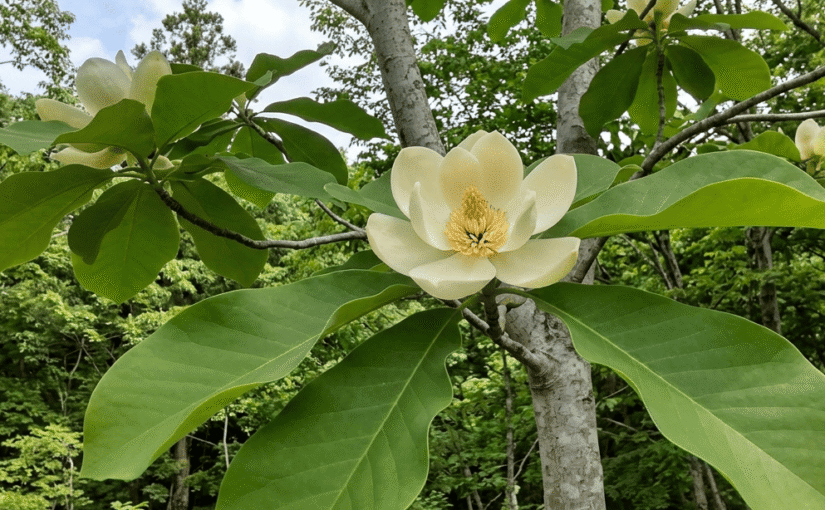
I want to dive into the world of “leaves that cook and serve.” Why leaves? For me, there is something deeply stirring about food wrapped in or resting upon a leaf. It is a sight that never fails to excite me.
Kaki-no-ha-zushi (sushi in persimmon leaves), Hoba-zushi (sushi on magnolia leaves), Sasa-dango (bamboo-wrapped dumplings)—just the thought of them engages all five senses. It’s enough to make anyone’s mouth water.
The Green Fans of the Forest: The Hoonoki
Among the many leaves used for wrapping food in Japan, the Hoonoki (Japanese Bigleaf Magnolia) has a singular presence. Looking up, you see them at the tips of high branches—massive leaves, large enough to cover a person’s face, spreading in a radial pattern. They are fittingly called “green fans.”
The Hoonoki is a tree native to Japan, growing wild across the archipelago since ancient times. This led me to look closer at what “Native to Japan” (Nippon-gensan) actually means in a botanical sense.
In Japan, “Native” generally refers to these two categories:
- Endemic Species (Koyu-shu):
Plants that exist wild only in Japan. About 40% of Japan’s flora are endemic, meaning they evolved uniquely on these islands. Examples include the Japanese Umbrella Pine (Koyamaki) and the Japanese False Cypress (Asunaro). - Indigenous Species (Jisei-shu):
Plants that occur naturally in Japan but are also native to neighboring regions like China or the Korean Peninsula. While Japan is their “original habitat,” they are distributed across a broader area of East Asia. Examples include the Japanese Hydrangea and the Balloon Flower.
The Hoonoki belongs to this second group, the Indigenous Species. It has adapted to the cool, temperate climates of East Asia over millennia, becoming an integral part of the Japanese landscape.
When you find yourself in the forest looking up at a Hoonoki, have you ever noticed that the ground at its feet is often clear, as if a deliberate space has been opened?
Allelopathy: The Art of Creating a “Personal Field”
If you notice a sudden, open space beneath a Hoonoki, you are witnessing a phenomenon called Allelopathy. This is a biological process where a plant produces biochemicals that influence the growth and development of other organisms. In the case of the Hoonoki, the main players are compounds found in its leaves, such as Magnolol and Honokiol.
Through this nature of Allelopathy, the tree releases substances from its roots and fallen leaves that inhibit the growth of surrounding plants. It essentially prevents competitors from sprouting nearby.
By monopolizing the nutrients in the soil and using its massive leaves to block out the sunlight from above, the Hoonoki ensures it has everything it needs to reach its overwhelming size. (Wait… putting it into words makes the tree sound a bit selfish, doesn’t it? Well, let’s just call it a “strong personality”!)
Three Reasons for Using Allelopathy:
- Monopolizing Sunlight:
The Hoonoki grows incredibly fast and requires a vast amount of light. By keeping other trees and plants at bay, it secures enough physical space to soak up the sun efficiently. - Monopolizing Nutrients:
Chemicals like Magnolol, Honokiol, and Costunolide wash out of the large leaves when it rains or as they decompose on the ground. This creates a zone where other seeds struggle to germinate, leaving all the moisture and soil nutrients for the Hoonoki alone. - Efficient Self-Sufficiency:
As mentioned before, the Hoonoki uses its own fallen leaves as fertilizer. By setting up a chemical “guardrail,” it ensures that its own nutrients aren’t stolen by outsiders.
Three Traits That Set It Apart from Other Trees:
- Giant Leaves as a “Lid”:
The leaves are among the largest in Japan (30–40 cm). When they pile up at the base of the tree, they act like a thick, insulating “lid.” This prevents the soil from drying out and regulates microbial activity in a way that perfectly suits the tree’s own roots. - Exclusive Consumption:
While fallen leaves from most trees nourish all surrounding plants and weeds, the Hoonoki is unique. Because its leaves contain growth inhibitors, the tree (and its specific symbiotic fungi) can keep all that recycled energy for itself. - Speed and Circulation:
As a “pioneer species” (sun-loving tree) that grows rapidly, the Hoonoki prioritizes a fast nutrient cycle. By dropping a massive volume of leaves every year and reabsorbing them exclusively, it employs a strategy that allows it to grow giant even in competitive environments.
While other trees might be “enriching the soil for everyone,” the Hoonoki feels more like it’s “building a barrier to create its own private farm.” Hmm… that still sounds a bit intense, doesn’t it? But I suppose in the world of the forest, it’s all about what you must do to survive!
Why is the Hoonoki Leaf Used in Cooking?
There is a botanical reason why Hoonoki leaves are used for food, and it goes far beyond the fact that they are “large and convenient.” The secret lies in the Allelopathy we just explored. The very substances the tree uses to guard its territory also act as natural antibacterial agents, helping to preserve food.
Long before the era of modern science, people in Japan understood through experience that food wrapped in Hoonoki leaves was less likely to spoil.
- Hoba-zushi (Sushi wrapped in Magnolia leaves): The antibacterial properties enhance preservation, making it a perfect, portable meal for long journeys.
- Hoba-mochi (Rice cakes wrapped in Magnolia leaves): When steamed, the protective compounds transfer to the rice cake, helping it stay fresh longer.
What began as a fierce strategy for survival—Allelopathy—eventually became a “natural preservative” that enriches our meals and protects us from food poisoning. (So, that “strong personality” I felt earlier is exactly what makes this possible!)
Dishes Starring the Hoonoki: A Feast for the Five Senses
Here are some traditional Japanese dishes that make the most of the Hoonoki’s unique character. It’s fascinating how the same leaf can take on entirely different expressions depending on the cooking method.
Note: It is generally recommended to use the leaves only once for cooking. However, if used simply as a decorative plate, they can be gently washed, dried, and reused.
Grilled Dishes: Dried Leaves and the Toasty Aroma
If you’ve ever stayed at a traditional Japanese inn or strolled through the historic streets of Hida Takayama, you may have noticed a savory, toasted aroma drifting through the air. More often than not, this scent comes from Hoba-yaki—a local specialty where miso and seasonal ingredients are grilled atop a large leaf.
For grilling, dried brown leaves collected in autumn are used rather than fresh green ones. Fresh leaves contain too much moisture, making them difficult to handle and preventing that signature toasted fragrance from developing. When heat is applied to a dried leaf, it releases a smoky, aromatic flavor that perfectly complements the rich depth of the miso.
Hida’s Hoba-miso
- The Secret to the Flavor: As the leaf heats up, it transfers a uniquely spicy and refreshing scent to the miso.
- Recommended Toppings: Chopped green onions, shiitake mushrooms, local mountain vegetables, and for a touch of luxury, the famous Hida Beef.
- How to Enjoy: The smell of the miso as it begins to caramelize is a true “rice thief“—an old Japanese expression for a dish so delicious you’ll find yourself reaching for bowl after bowl of white rice.
The first time I saw this, I was baffled. “A leaf on an open flame? Why doesn’t it burn?” I wanted to know the secret behind this magic!
Why Doesn’t the Leaf Burn?
It turns out the Hoonoki leaf has several “superpowers” that make it naturally flame-resistant.
- A Dense and Thick Structure
As one of the largest broadleaf trees in Japan, its leaves are incredibly thick with tightly packed fibers. This physical “strength” allows the leaf to endure high heat without crumbling, supporting the weight of the ingredients throughout the meal. - Heat Transfer and the Ingredients
Here’s the interesting part: the leaf doesn’t burn partly because of what’s sitting on top of it. The moisture from the miso and other ingredients seeps into the leaf, keeping its temperature from reaching the “ignition point” (the temperature at which it would catch fire). - The Wisdom of Soaking
There is a golden rule: always soak the dried leaf in water for a few minutes before cooking. By absorbing water, the leaf’s heat resistance increases significantly. This simple preparation transforms the leaf into a sturdy “cooking utensil” that can withstand open flames or glowing charcoal.
That distinct, spicy fragrance of a roasting Hoonoki leaf is even said to have a relaxing effect. Just feeling that it “smells wonderful” is a sign that the tree is already doing something good for your body!
Steamed Dishes: Fresh Green Leaves and Their Refreshing Scent
While grilling calls for dried leaves, dishes like Hoba-maki and Hoba-zushi rely on the “vibrant green leaves” harvested in early summer. The star of steamed dishes is the fresh, crisp aroma found only in these living leaves. Their natural flexibility makes them perfect for snugly wrapping ingredients, and that brilliant green color adds a sense of seasonal beauty and cleanliness to the meal.
Why Use Fresh Leaves for Steaming?
- Hot Steam and the Release of Fragrance
When touched by hot steam inside a steamer, the leaves release a refreshing, sweet, and cool scent—reminiscent of jasmine—that was locked inside. This aroma gently envelops the ingredients, adding an elegant, airy flavor that lingers on the palate. - A “Natural Barrier” That Protects
Using the leaves in steaming keeps the food clean while maintaining just the right amount of humidity, ensuring everything stays perfectly moist and tender.
Hoba-maki / Hoba-mochi
Think of this as the Hoonoki version of the famous Kashiwa-mochi (oak-wrapped rice cakes). It’s an essential treat for the Children’s Day festival in early May.
- The Magic of Scent: Because the rice cakes are wrapped in raw leaves before being steamed, the heat drives the aromatic compounds deep into the cake.
- A Taste of the Region: Especially beloved in areas like the Kiso region of Nagano Prefecture, these sweets are a cherished symbol that early summer has arrived.
Sushi: The Freshness of the Green Leaf
Hoba-zushi of Gifu and Nagano
A regional specialty from Gifu and Nagano that uses the lush, green leaves of early summer.
- Wisdom of the Ancestors: Utilizing the antibacterial properties of Allelopathy, this dish was born as a “spoil-resistant lunch” in the days before refrigerators.
- The Build: Vinegar-seasoned rice is topped with salmon, kyarabuki (simmered butterbur), and red pickled ginger, then tightly wrapped in the massive leaf.
- The Allure: After resting for a few hours, the fragrance of the leaf slowly infuses the rice, resulting in a beautifully refreshing flavor.
The Wisdom of Preservation: “Salt-Curing”
The vibrant green leaves of early summer are only available for a fleeting moment. To enjoy their refreshing scent all year round, people long ago developed the traditional method of salt-curing.
Fresh leaves are carefully washed and layered with salt under a heavy stone. This process prevents the leaves from turning brown and locks in that signature fresh aroma. When it’s time to use them, the leaves are soaked in water to remove the salt, and—like magic—their flexibility and fragrance return as if they were just picked. Thanks to this “salt-curing,” families in snowy regions could enjoy festive Hoba-zushi even in the dead of winter.
Modern Twists: Enjoying Hoba at Home
You don’t need a charcoal grill to enjoy this tradition. Using “dried Hoba” available in shops, you can easily use a frying pan or an electric griddle.
- Hoba Chan-chan Yaki: Grill salmon fillets and cabbage with miso on top of the leaf. Cod or mushrooms also work beautifully!
- Hoba Steaming: Wrap rice in a leaf and steam it. Try adding pre-cooked red beans or black beans for a fragrant treat.
The Bark as Medicine: Koboku
While we’ve focused on the leaves, the bark of the Hoonoki is also a treasure. Known as Koboku (Magnolia Bark), it has been a vital ingredient in traditional East Asian medicine for centuries.
- An Ally in a Stressful World: Relaxation Effects
The compounds we mentioned earlier—Honokiol and Magnolol—are known to help ease anxiety and calm the nervous system. It is a key ingredient in formulas like Hange-kobokuto, which is famous for relieving the sensation of a “lump in the throat” caused by stress. - Settling the Stomach: Digestive Support
The Hoonoki also steps in when you’ve overeaten or feel bloated. It helps stimulate the digestive tract and relieve gas. Eating meat with Hoba-miso is actually a very logical pairing from a health perspective! - Modern Science Takes Note: Antioxidant and Antibacterial Power
The same substances that fuel the tree’s Allelopathy (its “survival barrier”) are now being studied for their antioxidant properties. Because of its strong antibacterial power, you might even find Hoonoki extracts in toothpaste to help prevent gum disease.
In Closing
What do you think? The Hoonoki is a tree with a truly “strong personality,” yet it offers us so much—from its protective shade to its fragrant role in our kitchen.
The next time you come across these magnificent green fans, I hope you’ll take a moment to experience their unique charm for yourself!
Honoki at a Glance
| Item | Details |
|---|---|
| Common Name | Honoki (Japanese Magnolia) |
| Scientific Classification | Magnolia obovata (Deciduous tall tree) |
| Native Names & Aliases | Hoo, Hoo-gashiwa (Ancient name) |
| Flowering Season | May to June (Beautiful, large white blossoms) |
| Leaf Features | 30–40 cm long; the largest broadleaf tree leaf in Japan. |
| Distribution | Found throughout Japan (from Hokkaido to Kyushu). |
| Traditional Uses | Hoba Miso, Hoba-zushi, knife handles, sword sheaths, and herbal medicine (Koboku). |
A Name with Many Stories
- Hoo-gashiwa (The Ancient Vessel): This is the most common ancient name for the tree. In old Japanese, Kashiwa (or Kashiki-ha) was a general term for large leaves used as “cooking leaves” to hold or serve food. This name appears in ancient literature like the Man’yoshu, showing just how long we’ve been using these leaves as dinnerware!
- Pushni (Ainu Name): In the Ainu culture of Hokkaido, the tree is known as Pushni. The Ainu people have long cherished the Honoki wood for its beautiful grain, using it for intricate carvings and traditional crafts.
- Regional Charms (Local Dialects): Depending on where you travel in Japan, you might hear the tree called by different, colorful names:
- Ara: Used in parts of Okayama.
- Yama-itachi: Meaning “Mountain Weasel,” heard in parts of Kagoshima.
- Fuu-no-ki: A common variation heard in Kanagawa and other regions.